Now that I have your attention, I’d like to revisit a number of anomalies in Chapter H. I stumbled upon them in the course of designing scenarios for my forthcoming Close Combat pack. Avid readers of Sitrep may recall some of what I have to say from earlier posts. There’s nevertheless some value to be had in collecting and documenting all of this material in one place.
Vehicle and ordnance notes found in Chapter H of the ASL rules are neither comprehensive nor gospel. The late Paul Weir, an Irishman with a savant-like handle on armored fighting vehicles (AFV), understood this better than most. I don’t claim to share Paul’s expertise. Sadly, many of the publications he consulted are as rare as the surviving AFV of the last century. With these caveats at the outset, what follows are nine headscratchers to ponder.
I should begin by clarifying what I won’t be covering. For example, I won’t be bemoaning the absence of inconsequential command versions with elaborate aerial arrays. Obscure variants will likewise get a hard pass. Need I mention obvious physical differences that have no impact on play such as the largely redundant tailpieces fitted to the rear of French tanks such as the Hotchkiss 38H 735(f) below?1
.png) |
| Hotchkiss 38H 735(f) in Yugoslavia |
For what it’s worth, I’d much rather see the inclusion in Chapter H of the Krupp Protze 6x4 truck. Seven thousand saw service, many as light artillery tractors, in keeping with their designation as protze, or artillery prime mover. A number of third-party publishers have released counters for the Kfz 69/70 in German livery, although it should be noted that the Hungarians fielded them too. More numerous in Hungary was the country’s own 6x4 design, the Rába 38M Botond. Almost 1500 were built, each with a greater carrying and towing capacity than its German cousin. In addition to towing artillery, the Botond also served as a troop transporter in motorized infantry regiments. And yet despite their evident ubiquity and unique capabilities, the Krupp Protze and Botond may be officially listed as missing in action (MIA) in ASL.2
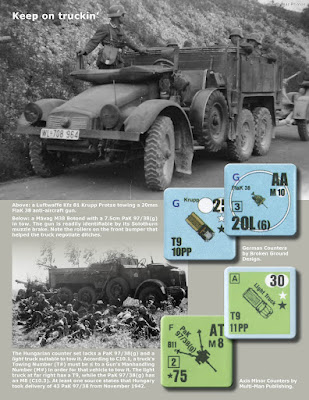 |
| Kfz 81 Krupp Protze and Mávag M38 Botond |
Enough wishful thinking. Let’s turn our attention to a pair of armored cars that saw combat during the Polish campaign of 1939.
Poland - Samochód pancerny wz. 34
I’ll try not to belabor the point, because I don’t have a problem with how ASL portrays the three models of the wz. 34 armored car. I will, however, remind armor antiquarians that a vehicle or ordnance listing is sometimes an amalgam of more than one model or type. This is the case with Polish Vehicle Note 7.
According to Chapter H, “the wz.34 and the wz.34-I were both armed with a 7.92mm Hotchkiss MG and the wz.34-II was armed with a 37mm Puteaux SA 18 gun.” Not exactly. The armament of a wz. 34 was unrelated to model type. The precedent, established with the wz. 28 armored car, was that vehicles assigned to platoon and squadron commanders had a Puteaux SA wz. 18. To quote a recent book on Polish armor, the wz. 34 “was an economical conversion of the wz. 28 in which the tracked rear suspension units were replaced with a wheeled axle.” In other words, the earliest wz. 34 was effectively a wheeled version of what had been a half-track.3
The vehicle note goes on to say that the wz.34-I counter in ASL represents both the original wz.34 and the later wz.34-I model, which ASL treats as MG-armed. The wz.34-II counter, meanwhile, represents the car armed with the 37mm gun. [My emphasis.] I’m fine with these abstractions. The two vehicles are readily distinguished by dint of main armament (MA), even though there was no such historical distinction.
A second nitpick is the Movement Point (MP) allotment assigned to each type. It’s true that the earlier versions were almost five km/h faster than the final model. The MP allotments mirror this difference. However, it appears that the newest model may have been the most numerous. Janusz Magnuski, for one, claims that of ten squadrons equipped with wz. 34 armored cars in September 1939, seven were composed entirely of wz. 34-II. Fifty-six cars seems high. However, Magnuski maintains that some earlier wz. 34 were rebuilt in 1938, meaning that there may well have been roughly 60 wz. 34-II when war broke out, or three quarters of the 80 wz. 34s mobilized in 1939.4 If correct, both ASL counters ought to have an MP allotment of 20 and be designated wz. 34-II. Interesting. The 71 Dywizjon Pancerny in my scenario “Dying Breed” was apparently among those squadrons equipped with wz. 34-II.
.jpeg) |
| wz. 28, wz. 34, and Peugeot 1918(f) armored cars |
Scenario designers are free to treat either counter as having two more or two less MP than printed where the model type is known. I didn’t bother; the difference is negilible in the context of “Dying Breed.” Again, the inconsistencies noted above are minor. The next pair of AFV are a different story.
Belgium - T-13
Unlike its predecessor, the MA of the T-13 Type II (Belgian Vehicle Note 15) was mounted in a turret. An improvement though it was, the turret faced the rear of the vehicle by default. The unwieldy design was more suited to gymnasts than tank hunters. In order to bring the gun to bear on a target lying outside the vehicle’s rear, the crew had first to lower armored shields on the front and the sides of the vehicle before the turret could be rotated fully. In the process the driver had to exit or risk injury. The vehicle note addresses these hurdles by requiring the vehicle to be stopped when changing Turret Covered Arc (TCA). Naturally, these armor acrobatics required more time to accomplish than is usually the case with a turret spin. Therefore, ASL also stipulates that a TCA change may not be made in the same Phase that the T-13 fires either of its weapons. Nor may the turret be rotated in any player turn in which the vehicle has moved. And yet, the vehicle is deemed to have Slow Turret Traverse (ST), as per D1.32. The latter designation makes absolutely no sense unless the vehicle is permitted to fire after changing TCA from front to side or vice versa. Absent any guidance in the vehicle note, it’s hard to conclude otherwise.
A more consequential omission is the apparent inability of the T-13 II to benefit from the hinged armor shield mounted on the front of the vehicle. When raised, it affords slightly better protection than the front armor of a universal carrier does: 13mm versus 10mm. Why then is this shield not considered a factor in determining the armor status of the T-13 II?5
I’d posit two reasons. Whoever drafted the vehicle note may have been unaware that the T-13 II had a front shield. Photographs consulted when the note was authored in the late 1990s may have provided no indication (or incontrovertible evidence) of a collapsible front shield. Or, the designers of Doomed Battalions, the module that doubled down on a host of early-war kookiness, were cognizant of the shield but chose to ignore it for the sake of simplicity. Not buying it! Consider the text and illustrated example devoted to the Nimbus (Danish Vehicle Note 24). The case for oversight is strengthed when one looks at how ASL models a similar Belgian TD.
 |
| Belgian T-13 Type II |
The T-13 Type III (Belgian Vehicle Note 16) also sports a turret, albeit a conventional front-toward-the-enemy one. While the turret provides better overhead protection than that of its directionally challenged frère, the vehicle remains Open Topped or OT (D1.23) in ASL parlance. An OT AFV is easy to spot in the game, because its overhead view is displayed on a white background.
Players will be familiar with the requirement of an OT AFV to be Crew Exposed or CE in order to fire a turreted weapon. Being exposed comes with risk. Risk is usually mitigated by a positive Dice Roll Modifier (DRM) that reflects the protection that a vehicle’s armor provides (D5.31). Protection is contingent, however, upon where the vehicle is struck. This is determined by cross-referencing an AFV’s Target-Facing and Aspect (C3.9). Target-Facing refers to whether the front, side, or rear of the vehicle faces the firer. Aspect is where a hit actually strikes: the hull or the turret (or upper-superstructure, in the case of a non-turreted AFV).
Ignoring Elevation Effects (D6.61) and Air Bursts (B13.3), the CE crew of a T-13 III is entitled to a +2 DRM to all fire regardless of Target-Facing and Aspect. This appears to overlook the fact that the turret wasn’t fully enclosed, leaving the gun crew vulnerable to fire from the rear. Another oversight? Maybe. Viewed from the front or side, the T-13 III could be mistaken for having an enclosed turret. But if that was the assumption, why was the vehicle classified as OT? Permit me to backtrack for a moment.
The turret Aspect of the earlier T-13 II is treated as unarmored to Direct Fire6 traced through the rear TCA (RTCA), regardless of the turret’s relation to the vehicle Covered Arc (VCA). In some cases, this vulnerability is broadened, as detailed in the vehicle note, to reflect the lack of protection through the side TCA when the turret isn’t aligned with the RVCA. Due to its more expansive turret, the T-13 III is rightly exempt from this second vulnerability. However, I fail to see why the T-13 III isn’t treated as unarmored to Direct Fire that strikes its rear turret Aspect, regardless of how its oriented.
 |
| Belgian T-13 Type III |
The question as to how these vehicles should be represented in ASL is up for debate. At least one thing could be clarified in a Q & A. Provided the turret isn’t currently aligned with the RVCA, may the T-13 II rotate its turret outside the RVCA and fire in the same Phase?
The front shield of the T-13 II is a little harder to address. Should it be abstracted to provide a +1 CE DRM on the rear turret Aspect similar to the way many French tanks are treated?7 Or should a counter be used to indicate the status of the shield, perhaps along with the status of the side shields that could be raised after the turret was rotated? A generic DRM appears to be a more workable solution. Were this to be adopted, could a case also be made for the DRM to apply irrespective of turret alignment? The answer is important because it has bearing on how to treat the turret of the later model.
My earlier post has more detail on these Belgian beaus and I encourage players less familiar with the T-13 to consult this material before continuing.
Italy - Autoblindo Fiat 611A
The Autoblindo 611 (Italian Vehicle Note 20) is another curiosity of the 30s. The Royal Italian Army was disinterested in armored cars (AC) at the beginning of the decade. The Carabinieri took a different view and Ansaldo-FIAT manufactured 46 armored police cars in 1932. There were two variants. One had a 37mm gun and a rear-facing machine gun (MG) in the turret, the other a pair of offset MG. Both AC also had an MG mounted in the hull next to the rear driver’s seat. In 1934 the Regio Esercito changed its tune and confiscated the vehicles for military use in Africa. These AFV participated in the second Italo-Ethiopian War and more generally in East Africa during the early stages of the Second World War. My scenario “Tug of War” is set in the Somaliland Protectorate and features a pair of the MG-only cars supporting an Italian attack in August 1940.
 |
| Fiat AB 611A |
My criticism of the FIAT 611 in ASL is limited to the MG-only car, designated a Fiat 611A in Chapter H. The counter depiction is correct in having no turret Rear MG (D1.82). However, the counter errs in having a Firepower (FP) Factor for a turret Rear MG. Note the superscript “R2” after the Coaxial MG (CMG) value of 8 FP as seen on the counter in the preceding slide. Erratum would fix this in a jiffy.
France - Renault FT-17 75 BS
I thought it would be fun to include a seldom seen tankette in “Day of the Jackals,” a scenario of mine where the Vichy French counterattack a British force in the Golan Heights. As opposed to other AFV in this article, I only twigged to a problem when I saw a post on an ASL forum earlier this month.
The FT 75 BS (FT-17 75BS: French Vehicle Note 1) was rushed into production during the last year of the Great War. It was intended to provide improved direct fire support by replacing the diminuitive 37mm Puteaux SA 18 of the Char canon (the FT-17C in ASL) with a short-barreled 75mm Blockhaus Schneider. It was France’s second attempt to marry substantive firepower with mobility. The Char d’assaut Schneider, more commonly known as the Schneider CA, was what we would we call today an assault gun. Its 75mm BS howitzer was fitted to the starboard side of the Schneider CA, drastically limiting its field of view. A ball mount mitigated this to a certain extent, allowing a traverse of 60 degrees. If only the same weapon could be mounted in a turret so that the howitzer’s full potential could be realized.
The Char canon de 75S was the child of an awkard marriage of FT and BS. Because the howitzer required a larger housing than the turret ring could accommodate, plans for a turret were dashed. Instead, Renault built a fully-enclosed casemate to protect the gun and its two-man crew. On balance, the Renault self-propelled assault gun was an improvement over the Schneider CA. But a tank it was not. And therein lies the problem.
That counter buried beneath a pile of seldom used AFV in your kit is masquerading as a tank!8 There are four, thick white lines surrounding the (erroneous) depiction on the FT-17 75BS counter. As per D 1.322, this indicates that the AFV has a One-Man Turret (1MT). As I’ve already established, this variant of the Renault FT has no turret. If it did, it could hardly be called a 1MT. So what should we do about it?
Renault delivered 39 or 40 vehicles to the French army between 1918 and 1919. During the interwar period the majority found their way to France’s colonies as well as the French Mandate for Syria and the Lebanon. The Chapter H note tells us that 54 Renault FT were in the Levant. According to the same note, the French organized these AFV in sections of six. In theory, each section had one FT-17 75BS assigned to it. Taken at face value, there may have been as many as nine Renault 75BS assault guns in the Lebanon and Syria in 1941. I doubt that more than a handful were serviceable, but the possibility of encountering one certainly existed. There are also reports of these antiques in American accounts of fighting in North Africa. On the whole, however, this AFV rarely appeared in a scenario order of battle (OB), until quite recently. Excluding “Day of the Jackals,” the ASL Scenario Archive lists six scenarios as having a FT-17 75BS in the mix. One is set in Algeria, two (surprise!) in metropolitan France, one in the Lebanon, and two in Madagascar of all places—all in third-party publications.
Still, the need for erratum isn’t exactly pressing. Although half of the scenarios starring le Charette sans tourelle were released just four years ago, I’m not aware of anyone clamouring for a corrected counter 33 years after the AFV debuted in la Croix de Guerre originale. Robert Fabbro did question the presence of turret in a post on GameSquad in October 2018. The “Da Paul Challenge” thread, in which it was posted, was a place where players sought advice from Mr. Weir. The thread ran to more than 2,400 posts over course of seven years. Paul’s response was nevertheless guarded:
The FT-17 BS: I have yet to see a photo of a BS with a turned turret. Not that could be taken as definite, there were only 39/40 built and from memory 70%+ of the FT-17 photos of the 37* and MG armed vehicles have the turret at the 12 o’clock position, so we could be unlucky. However I’m inclined to think it should be NT [non-turreted], just too restricted in usable space. Apparently there were 33 still in service in NA [North Africa], Syria and Indochina, out of a total of 163 FTs overseas, so should not appear in any 1940 scenario. The Allies were reported as coming across 2 of them in NA [North Africa].
Paul’s point regarding 1940 is noteworthy given that Sherry Enterprises published the fittingly titled “Tirailleurs and Antiques” in 2021. Among the antiques that can be found defending the French town of Manicamp in June 1940 is our Blockhaus buddy.
Maybe it’s worth an erratum after all. But what would that look like?
 |
| Renault FT 75 BS, FT TSF, and FT M1931 |
It goes without saying that the 1MT symbols must go. And while we’re at it, we may as well replace the counter depiction. To further differentiate the FT-17 75BS from its siblings, the special +1 CE DRM also should be dropped. The DRM is a reflection of the fact that the turret of the FT had a small hatch at the rear that allowed the tank commander to sit on the rear hull leaving his backside exposed to fire from above and behind. No such hatch existed on the FT-17 75BS. Instead, convential hatches located in the top of the gun casemate arguably merit the standard +2 CE DRM.
We would be done at this point were it not for a special vulnerability encapsulated in the 1MT rules, namely Recall. Whenever an AFV with a 1MT suffers a Stun result (D5.34), it’s subject to Recall (D5.341). I raised this point on GameSquad. Bruce Probst made a case for retaining this effect of a 1MT for the FT-17 75BS. He argued that the presence of a second crewman in the upper hull didn’t preclude the fact that only one of them was in charge of the vehicle. Bruce surmised that French doctrine wouldn’t have encouraged the loader to take charge were his commander to become incapacitated. There is an unspoken assumption in his argument that a Stun result is a conseqence of the commander being the target or victim of the attack. However, it’s worth remembering that the commander, who doubled as the gunner, likely had more expertise in the operation of the howitzer. With him out of the picture, the effeciency of the crew would understandably degrade. How much remains a matter of debate. That said, the vehicle was the backbone of the section. Preserving it to fight another day makes sense. If you agree with Bruce, then perhaps the FT-17 75BS warrants something akin to Italian Multi-Applicable Vehicle Note (MAVN) E below:
If stunned, this AFV may not regain CE status, may not fire any weapon, and is Recalled as per D5.341; these are signified by “Stun=Recall & CE/FP NA” on the counter.
Then again, the number of scenarios where this AFV is likely to appear is limited. Therefore it may be easier to use a Scenario Special Rule (SSR) to address the discrepancies I’ve highlighted above. I haven’t taken this approach with “Day of the Jackals.” Should I?
Hungary - 39M Csaba
The next exposé is a twofer, a two-for-one deal. I never intended it to be so; it just worked out that way.
A dozen scenarios have at least one 39M Csaba armored car in their orders of battle. “Rubber Hussars,” my take on a Hungarian-Soviet engagement in the Ukraine, has three. On the face of it, the 38M Toldi I light tank has little in common with its wheeled compatriot. In spite of this, an important connection has been overlooked since the publication of Armies of Oblivion in 2006. They share the same armament. However, when fighting side by side, as they do in two scenarios in the module, ASL treats them differently in four respects.
Hungarian Vehicle Note 7 states that the Toldi I “was armed with the 20mm 36M AT rifle (the Swiss Solothurn built under license) and an 8mm Gebauer 34/37 MG installed in the turret.” The same note explains that the Gebauer (also known as the Solothurn 31.M Golyószóró) could serve in an anti-aircraft (AA) role by mounting it on a special support on top of the turret. (A special dispensation in Hungarian MAVN A allows the MG to retain its 4-FP rating.) Because the MA is an anti-tank rifle (ATR), it has a maximum To Hit range of 12 hexes, which explains the notation “*[12] TH” on the back of the counter. On the plus side, the vehicle note allows the ATR to be Scrounged (D10.5).
According to Hungarian Vehicle Note 14, the 39M Csaba “mounted a 20mm gun and an 8mm MG in the turret.” Unfortunately, the vehicle note doesn’t elaborate on the type of gun. It was, in fact, a 36M 20mm Nehézpuska, a Solothurn S-18/100 20mm ATR manufactured under license in Hungary.9 Sound familiar? It gets better. Like the Toldi I, the CMG of the Csaba could function as an AAMG when fixed to a bracket inside the rear of the turret, as shown in the slide below. However, the vehicle note doesn’t allow for this switch.
The 38M Toldi and the 39M Csaba were armed identically and should be treated accordingly. The Support Weapon (SW) version of the Solothurn S-18/100 ATR has a maximum range in ASL of 12 hexes or 480 metres. I’ve read, however, that the Hungarian 36M anti-tank rifle could penetrate 10mm of armor (at 60°) out to 600 metres, or 15 hexes. Ten millimetres translates somewhere around Armor Factor (AF) 1 in ASL (D1.6). I think it’s fair to assume that the ATR’s range would benefit from a fixed mount. In that case, a maximum range of 15 or even 18 hexes isn’t far fetched. Accuracy would suffer, as the C4 Table demonstrates, but not penetration (C7.31 Table). Whatever the adjusted range ought to be, it should be the same for both vehicles.
Rate of Fire (ROF) should likewise be the same. The SW version has ROF 2. Following convention, I’d therefore expect the MA to have an ROF 1, or one lower than its SW counterpart, which I might add is the current ROF of the Toldi I.
 |
| 39M Csaba, Toldi I, 8mm 31M Solothurn, and 20mm Solothurn ATR |
Should the powers that be decide to reconcile these MA, together with their range and ROF, MMP would do well to address two additional discrepancies at the same time. The Csaba vehicle note should allow the ATR to be scrounged and the CMG to be repositioned as an AAMG. The first change is self evident. The second is a little different because it introduces an heretofore unknown feature. I accept that few players will ever take advantage of this capability per se. However, its tactical importance increases when one learns that D10.51 permits a “CMG that may be repositioned as AAMG [to] be Scrounged.” Welcome news for the hapless crew of an Immobilized Csaba with a malfunctioned MA.
The Netherlands - VCL M1936 Vechtwagen
I unearthed the last bones of contention during an online dig in the Dutch East Indies. There the Royal Netherlands East Indies Army—better known by its Dutch acronyn KNIL (Koninklijk Nederlands Indisch Leger), fielded an armored force far more impressive than anything the Netherlands could muster during the German invasion of 1940. Futuristic Overvalwagen were among a host of armored curiousities to be found on Java. However you’ll search in vain for a pale-green counter of these wheeled, armored personnel carriers (APC) or the cutting edge Alvis-Straussler armored car, the forerunner of the Csaba.10
Also MIA in the fourth edition of Doomed Battalions is the “southpaw” version of the Combat Tank Light Series 4 (Dutch Vehicle Note 26). I touched on this omission in my article about “Tin Omen” a year ago. At the time, I presented a photograph that suggested the presence on Java of CTLS-4 with port-side turrets. I’ve since learned though that the image may be of a vehicle that arrived after the war, when the Dutch transferred a number of their tanks from their West Indian colony of Surinam to the East Indies. I refer those interested in learning more about the subject to the footnote at the end of this article.11
Far more contentious is the counter used to represent the 17 Vickers-Carden-Loyd M1936 tanks that were operational when the Japanese invaded Java. Dutch Vehicle Note 25 states that the Netherlands had ordered 73 “VCL Model B 1935 light tank (Chinese Vehicle Note 1) in 1935” and designated them “VCL model 36 vechtwagen (fighting vehicle).” The KNIL did order 73 VCL light tanks on 8 March 1939. But the vehicles the Netherlands began taking delivery of in July 1939 were very different from those described in the Chinese note cited above.
The cramped, low-profile amphibious tankette referenced is an early model based on A4E11 and A4E12 protypes developed in 1931 and 1932. The Chinese vehicle note acknowledges as much and thus refers to this tankette as the “VCL M1931.”
I believe the confusion stems from an earlier Dutch order for two amphibious tankettes placed in 1936 and received on 9 November 1937. A pair of light tanks from an order placed on 21 December 1936 arrived the same day. The four AFV were purchased for trials and underwent rigourous tests in 1938. Assessments of the light tank proved positive, but the amphibious tankette struggled to climb river banks and one sank during a crossing. Consequently no additional tankettes were purchased.
A couple more things to clear up before I cast light upon the Dutch vehicle counter itself. The only “M1935” version that I’m aware of was a customized M1934 tank sold to Belgium in 1934. The Char Léger de Reconnaissance Vickers-Carden-Loyd Mod.1934 T.15 (Belgian Vehicle Note 17) differed from the standard M1934 in having a conical rather than a cyclindrical turret, along with a more powerful engine. The M1936 was exported to China and the Netherlands. With the outbreak of war in Europe, some M1936 remained in Britain where they were used as training vehicles and dubbed “Dutchmen.”
Although the trial pair of VCL tanks differed from later arrivals in sporting twin 7.7mm Colt machine guns, they were, like all VCL light tanks in KNIL service, M1936. My first post on the subject has a photograph of three of the test vehicles side by side. Below are the M1936 as they were configured when the Japanese invaded.
 |
| Vickers-Carden-Loyd M1936 "Dutchmen" and VCL M1931 |
Need I point out that the amphibious MP allotment (D1.1) on the VCL M1936 counter is superfluous? (For those new to the game, that would be the numerical superscript to the right of the MP number.) Another problem is the vehicle size. The white dots behind both AF indicate that the vehicle is considered a very small target (D1.75). That makes sense for a low-profile tankette like the VCL M1931, less so for the M1936. Consider the aforementioned Belgian T-15. It’s a VCL with the same footprint as the M1936, but is rated as a small target (D1.74). The VCL M1936 ought to be treated the same. Likewise, AF of the current vehicle counter are inferior to that of similar VCL such as the Belgian T-13 and T-15. Armor Factors may therefore require adjustment. Lastly, despite a change to the counter depiction from previous editions of Doomed Battalions, the image still doesn’t reflect the actual vehicle. To my eye it looks suspiciously like the amphibious M1931 tankette.
Whole lotta errata
There’s much to consider, not least how any changes would work in the context of other rules. Changes are hardly unprecedented however. The three-ring binder, long cherished by ASL players, was designed to facilitate amendments. Updating counters is different. Fortunately, MMP has a solid track record of periodically issuing corrected counters in new releases. Whether the stewards of ASL choose to heed any of my suggestions is another matter.
If you enjoyed this article, you may be interested in other posts on a range of topics beloved of grognards. Should you wish to learn more about scenarios featuring tin cans, I recommend that you have a look at my Close Combat page. Thanks for reading!
Notes
1. Designed to aid in crossing Great-War era trenches, I found nothing to indicate either their presence or usefulness while in German service on the eastern front where “Booty Call” is set.
2. Russian Vehicle Note 47 describes three Soviet trucks commonly found in motorized and mechanized units. They include the GAZ-MM (light), the ZIS-5 (medium), and the IAG-6 (heavy) truck. In contrast, German Vehicle Note 96 has only two entries: a (medium) Opel 6700 and a (heavy) Buessnig-NAG truck. Why no light truck for the Wehrmacht?
3. Jamie Prenatt, Polish Armor of the Blitzkrieg (Osprey, 2015), p. 36.
4. Janusz Magnuski, Samochód pancerny wz.34, TBiU nr 56 (Wydawnictwo Ministerstwa Obrony Narodowej, Warszawa 1979); and Prenatt, Polish Armor, p .38.
5. It’s possible, however unlikely, that the shield was somehow factored in whenever the vehicle was Buttoned Up or BU (D5.2). Seems a stretch to me.
6. The index of the ASL Rule Book defines Direct Fire as “Any fire attack requiring a LOS from the firer which does not use Indirect Fire.” Simply put, Indirect Fire is restricted to mortars and Offboard Artillery (OBA).
7. I’m referring here to French MAVN C, which states that the CE DRM is +1 versus “Direct Fire that emanates from within the turret’s rear Target Facing.”
8. I know, I know. It’s technically a tankette, but I defy you to find the term defined in the rules. Good luck finding a definition of tank while you’re at it. Granted certain vehicle listings identify this or that AFV as a tankette, but this list includes vehicles that are turretless. A tank, by definition, has a turret. As an aside, official French documents apparently refer to these AFV as Renault FT or simply FT, never FT-17.
9. Steven J Zaloga, The Anti-Tank Rifle (Osprey Publishing, 2018), p.22.
10. The armored car was named after the British company (Alvis) and its Hungarian-born designer Straussler Miklós Péter. Bounding Fire Production included counters for the Braat APC and the Alvis-Straussler AC in Blood and Jungle, first released in 2010. The KNIL had twelve AC equally distributed among four cavalry units.
11. CTLS-4 with turrets mounted on the starboard side of the tank were officially designated as CTLS-4TAC. Adjacent to the turret is a raised driver compartment that limits turret rotation to 270 degrees. There is speculation that military doctrine required these vehicles to operate in pairs with one vehicle having a turret on the port side—the CTLS-4TAY—to complement the starboard-side turret of its partner. I’m unable to confirm this. Photographs nonetheless reveal that the Dutch colony of Surinam took delivery of a combination of 26 CTLS-4TAC and CTLS-4TAY in 1942, as did Curaçao, which only received seven. The question remains whether any of the CTLS-4 that arrived in Java had port-side turrets. To put a finer point on it, was the platoon of seven CTLS-4 that saw action in March 1942 composed entirely of CTLS-4TAC, as Dutch Vehicle Note 26 inadvertently presupposes?
 |
| Combat Tank Light Series - CTLS-4 in Dutch service |
Possibly. The Straat Soenda was carrying 80 CTLS-4 when it ran aground off Java on 20 January 1942. The bulk of its cargo was eventually offloaded. However, the main hold was partially flooded, likely damaging some of the tanks stowed there. This jibes with the vehicle note in Chapter H which states that:
In mid-February, the first of twenty-four Marmon-Herrington CTLS-4 Light Tanks were delivered to the Dutch forces in Java. The tanks arrived without armament, but machine guns similar to the Browning .30-caliber were procured from the Dutch Air Force and used to equip the vehicles. The first seven crews to be trained in the tank were issued vehicles on February 27, the day before the Japanese invaded Java. The KNIL surrendered on March 8, 1942, and the Japanese occupation forces found over a dozen of these vehicles in working order and quickly put them into service.
It’s possible, therefore, that any CTLS-4TAY on the grounded merchant ship didn’t come ashore in time to be fitted with MG, let alone see combat. This remains a matter of speculation, however, as virtually every photograph that can be attributed to pre-1945, including several CTLS-4 in Japanese service, have starboard-side turrets. An illustration in Marc Lohnstein’s 2021 book on the Netherlands East Indies campaign nevertheless implies that at least one did. Graham Turner’s painting is either artistic licence or based on evidence that the KNIL sent both versions into combat. The author fails to elaborate, noting only that Allied tank strength on Java was comprised of 40 light tanks, seven of which were “Marmon-Herrington CTLS-4TA.” I welcome insight from readers who can provide a definitive answer either way.


.png)
.jpeg)


