Francs-tireurs anonyme: «Allô, je suis X, et je suis un...»
Many players in France were upset when Tactiques ceased publication in 1995. Laurent Closier and a small circle of dedicated French players had tried to emulate the success of Théophile Monnier’s ground-breaking ASL magazine. However, the momentum that had carried Tactiques forward appeared to dissipate as the century waned. One of those most disappointed by the loss of Tactiques was Xavier Vitry. Gone was the only dedicated resource for ASL in French. The Internet was still in its infancy. There was no profusion of ASL-related web sites, no forums or mailing lists for French players to share news, exchange ideas, or publicize events. All that remained were dated, dog-eared copies of Tactiques, and the occasional ASL scenario or article in Vae Victis.

Regrettably, Xavier was not in a position to do anything about the demise of Tactiques. And when LFT folded three years later, he found himself posted to Tahiti, as part of France’s Troupes de la marine garrison stationed in Papeete.15 Upon his return to metropolitan France two years later, Xavier resolved to create an enduring successor to Tactiques. He broached the idea with a number of French ASL players. Laurent Closier suggested that Xavier resurrect and build upon the LFT name. Xavier accepted Laurent’s gracious offer, and “Hulk” reciprocated by joining the LFT crew. A number of other ASL luminaries in France also answered the clarion call. Thirteen years later, the production quality of “quatre-vingts”—LFT’s trademark 80-page magazine—has become the benchmark by which ASL publications are measured.16 The magazine is produced in colour on heavy-weight, coated paper. It includes, at a minimum, 10 scenarios on separate A4 (210mm × 297mm/8.3" × 11.7") coated cards. However, the polished periodical is but one element of the successful LFT franchise.

I would like to take a closer look at the magazine, as well as a number of other LFT publications. Before I do, I want to emphasize that a great many people deserve credit for the success of France’s remarkable ASL “publishing house.” Gentlemen the likes of Laurent Closier, Philippe Naud, Alexandre Rousse-Lacordaire, and Jean Devaux represent only a fraction of those who have contributed to LFT on a regular basis. So if I fail to mention some of the more prominent movers and shakers among the LFT crew do not consider it an oversight, or worse, a slight. It may surprise you to learn that even today some of Xavier’s team remain a tad bashful, and prefer anonymity over notoriety.17
From rag to richness
The revamped LFT literally began where Laurent Closier’s last issue of LFT had left off, in the mountains of southeastern France. Even the scenario numbering system was retained.18 Therefore, when numero cinq was published in 2000, one could be forgiven for thinking that it was the same magazine. It was not.
 |
| Le Franc Tireur No. 5 |
There were similarities. Historical articles and scenarios were linked by a specific theme. In LFT 3, it was the mountain warfare that took place along the Franco-Italian border in (1940 and 1945). In LFT 5, it was the battles atop the Massif de l’Authion in April 1945, along the same frontier. And whereas the Laurent Closier’s 1998 issue discussed how pillboxes worked in ASL, Xavier Vitry’s inaugural issue examined minefields. Each magazine also contained reviews and announcements of new ASL publications. There was some coverage of the tournament scene, especially in Europe. The text was in French. Colour was used sparingly on both covers. The layout of the scenario cards under Laurent was very similar to that used by Avalon Hill. Xavier took this a step further, and added more colour.
 |
A Gallic approach to the humble scenario card
|
Some differences were subtle. The hyphen in “Franc-Tireur” was dropped, while the subtitle “Le magazine des fanatiques d’ASL” was added—a nod to Tactiques. Colour photographs graced the inside of the back cover and provided readers with a comparative snapshot of Authion as it appeared in 2000. On the page opposite were black and white photographs of the same scenes taken during the war. At 46 pages, the reborn LFT was not much bigger than its predecessor. As we shall see, LFT 5 was but a tentative first step. It was arguably the same case with the scenarios; there were six. One was a light-hearted parody. The remaining five brought to life the Battle of Authion. Taking a page from Tactiques, LFT 5 included a small colour overlay for use with one of the scenarios. However, the biggest departure from the original LFT magazine was that all of the scenarios were published in English.19 The new editor-in-chief had set an important precedent.
 |
| Authion's Alamo |
 |
| Le Franc Tireur No. 6 |
Under Xavier Vitry, LFT continued to evolve, and expand. Issue No. 6 was published in 2001. The magazine was a whopping 92 pages, not counting ten new scenario designs, a pair of bonus scenarios,20 a player aid, and a colour overlay of El Alcazar de Toledo (the citadel of Toledo). The theme was the Spanish Civil War (1936-39), and eleven of the scenarios reflected this. Again, the scenarios were published in English. The text of the magazine remained French. LFT 6 was my introduction to the French publisher, and remains the earliest issue of LFT in my collection. One aspect that impressed me was the annotated bibliography, complete with thumbnail photographs of 18 titles on the Guerra de España.
 |
| Le Franc Tireur No. 7 |
The seventh issue, published in 2002, largely stuck to the formula of the previous year. Ten scenarios on cardstock dealt with engagements during Operation Barbarossa (June-December 1941), as did several of the articles. As coincidence apparently would have it, many of the scenarios in LFT 7 were republished in ASL Journal 7. “The Yelnya Bridge,” “Last Push to Mozhaisk,” “Borodino Train Station,” “Flanking Flamethrowers,” and “Lenin’s Sons” have become perennial tourney fare. The last scenario is a personal favourite, and coincidentally, among Xavier Vitry’s favourite designs.21
 |
| LFT aerosan |
The small sheet of overlays included six unmounted counters representing aerosani (аэросани), or “aerosleds.” Picture an airboat22 skimming across the Everglades and you get an idea of what these sleds were capable of on a frozen waterway. To my knowledge, Jean Devaux’s scenario is the first recorded use of these snow machines in ASL. Although the accompanying historical article on aerosleds appeared in French, the rules for employing them in ASL were entirely in English. The latter concession to the lingua franca of ASL made eminent sense. The concession also heralded an editorial shift that led to the first widespread use of English in the magazine.

 |
| Le Franc Tireur No. 8 |
When LFT 8 hit the street in 2004, only a quarter of the content remained in French. The Battle of Normandy steals the show in this 92-page issue. The historical articles and annotated bibliography dealing with the subject were in English. So too were most after-action reports, along with the first of a two-part tutorial on the Overrun process.
The illustrated tour of the Mortain battlefield penned by Laurent Closier makes for interesting reading, even today. At the time, there were only a fistful of ASL scenarios dealing with the German attempt to cut off General Patton’s Third Army in August 1944.23 In Closier’s estimation, there was plenty of scope for a dozen more scenarios portraying the week-long battle.24 He made this comment in light of the fact that LFT 8 contained his own ASL contribution to the Battle of Mortain entitled “Greyhound at Bay.”25 Eight years later, Operation Lüttich, as the Germans referred to their counteroffensive, remains largely unexplored by ASL designers.
 |
| Battle of Mortain, 7-13 August 1944 |
The next issue of LFT did not appear until 2006. The delay can be attributed largely to the posting abroad of its editor-in-chief. The illness, and subsequent death, of long-time contributor Jean Devaux was another factor. Sadly, Monsieur «5+2» passed away only days after the publication of LFT 9. He never saw the fruits of his latest labours in print. His labours were substantial. In addition to the second part of his tutorial on the Overrun, Jean reviewed more than half a dozen new ASL publications, designed or co-designed four scenarios, and contributed his signature brand of “lighter” ASL humour to the magazine.
 |
| Le Franc Tireur No. 9 |
The magazine was shorter than usual. At 80 pages, LFT 9 was the first issue to be printed in Cambodia. Lower printing costs apparently made a new glossy, all-colour cover affordable, thereby setting the standard for future editions of all LFT publications. The concessions to real-world demands notwithstanding, the ninth issue of LFT continued to deliver much ASL goodness, 80 percent of which appeared in English.26 Yugoslavia was the theme of the scenarios, which were mirrored by historical articles on the Cossacks and 7. SS Freiwilligen Gebirgsjäger Division “Prinz Eugen.” The only extra was a sheet of two hill overlays. However, the scenarios offered plenty of variety, including rules that allowed three scenarios to be linked into a mini campaign game (CG) of sorts. Allied Special Forces, Cossack cavalry, Croats, Italians, armour of Tito’s Partisan Army, and Yugoslav air support make for an interesting mix of situations during four-years of frequently fratricidal fighting in the land of the southern Slavs.
 |
| Overlays FT6 and FT7 were included in Le Franc Tireur No. 9 |
The transformation begun in LFT 9 was completed in the follow-up issue, published little more than six months later. The magazine had come of age. From the spectacular cover art to the polished, four-colour layout, LFT 10 was a watershed for the French publisher. Perhaps 95 percent of the magazine was now in English. Not content to set a new standard among ASL magazines, LFT included a small counter sheet as a supplement.27
 |
| LFT10 counter sheet |
La División Azul—the (Spanish) Blue Division—received top billing in the tenth issue of LFT. All of the scenarios in the magazine have a Spanish order of battle, including one scenario set in Berlin on 27 April 1945.28 Xavier Vitry provided a historical summary of the Spanish volunteers, while Philippe Naud contributed a wonderfully illustrated piece on the Battle of Krasny Bor (February 1943). The Spaniards lost some 1200 killed or missing during the first day of this epic Ostfront clash.29 Noted Spanish historian Carlos Caballero Jurado was a contributing editor in LFT 10. A specialist on the Eastern Front, he proofread the articles and the scenario cards, and provided valuable advice. Xavier’s interview with this widely published author is an added treat.
Photographs, maps, and entertaining ‘toons abound in the 2007 issue of LFT. The magazine’s official cartoonist, Emmanuel Batisse, aka “Manu,” was in fine form. The inclusion of the “Gates of the Reich” CG, originally published in French in Vae Victis No. 15, was icing on the cake. The CG was the product of a collaboration between Jena-Luc Béchennec, Jean Devaux, and Philippe Naud. LFT 10 was everything that the Rédacteur en chef of LFT could have hoped for, a fitting tribute to fellow franc-tireur Jean Devaux.
 |
| The Hispanic Connection |
Issues 11 and 12—published in 2008 and 2010, respectively—replicated the high standards set in 2007. Each magazine was stuffed with 80 pages of ASL goodness, and ten scenarios on separate cardstock. Each magazine nonetheless broke new ground for the publisher with the inclusion of geomorphic mapboards on heavy cardstock. LFT 11 explored the travails of the French army in 1940. Articles on Stonne, and Platoon Movement (D14.2), for example, encouraged players to sample this period of the war.30 My favourite article title is: “France 1940: Instructions for Use,” which reviewed the major rule sets that players should be cognizant of before play. Eight scenarios involved French forces in Belgium, and northern France. Another scenario played out along the Franco-Italian frontier—where the Italians were keen to acquire more beach-front property on the Riviera.
 |
| Le Franc Tireur No. 11 |
Laurent Closier designed the tenth scenario in the magazine. FT98 “And Then They Landed” is set in Indochina during 1940. The locale is enough to make the scenario unique. But its uniqueness does not end there. The scenario involves a beach landing by the Japanese. LFT kindly supplied the beach. Okay, a cardboard one, but a “beach” board nonetheless. As Mark Pitcavage pointed out on his website, board LFT1 alleviates the need for the cumbersome beach and ocean overlays that came with the ASL module Gung Ho!. Now before you dismiss this scenario out of hand, I urge you to give it a closer look. It is small and uncomplicated. Apart from five Japanese Shohatsu landing craft, the orders of battle consist only of Infantry and support weapons. The scenario can therefore serve as a good primer for getting your head around the basics of a seaborne-assault (G14).
 |
| Not exactly the French Riviera, but it beats using overlays. |
 |
| Le Franc Tireur No. 12 |
Still intimidated by the prospect of a seaborne assault? Then perhaps the China at War issue of LFT has what you are looking for. LFT 12 is a made-in-Indochina, splash-in-the-sand frolic for fans of the Pacific Theatre (PTO). The amply illustrated “Sons of Beaches” will help you find your sea legs. After wading through the eight-page tutorial, “Seaborne Assaults” puts you on board a Canadian landing craft headed for Juno Beach.31 This partial “series replay” walks you through the first half of a scenario, allowing you to see how cardboard Canadians hit the beaches in ASL.
Hold on! Where are the Chinese? On the beach in FT136 “Shanghai by the Sea,” patiently awaiting the arrival of six Shohatsu. FT136 marries board 49 with the LFT1 beach board from LFT 11. As with Laurent Closier’s FT98, Jean-Pascal Paoli’s FT136 is essentially an infantry-only affair, albeit set in 1937, rather than in 1940. All told, eight out of ten scenarios in LFT 12 involve the Chinese. The most unusual may well be FT145 “Bears of Kinmen.” The presence of board LFT1 signals another seaborne assault. However, this time the Chinese find themselves in the landing craft, and on shore (see box below for details).
 |
| Wooden ships and iron Kinmen |
LFT 12 provides a beginner’s guide to the PTO. The magazine reviews the unique traits of the Chinese (GMD and “Reds”), the Japanese, and the US forces specific to the Pacific Theatre, including the Philippine Army. Also reviewed are the terrain types unique to this theatre, as well as the mutually-assured-destruction (MAD) nature of Close Combat versus the Japanese (G1.64) A copiously illustrated example of a Banzai charge rounds out the PTO briefing.32 The review of PTO terrain is welcome, especially given that six of the scenarios in the magazine are fought in this terrain. Two of these scenarios are remarkable because they use board LFT2, a board dominated by a big, level-five hill covered in Kunai (grain), interspersed with palms (orchards) and patches of jungle (woods).33 All in all, LFT 12 is a solid effort at cultivating an interest in the terrain and combat of the Pacific Theatre.
Onward and upward
 |
| Le Franc Tireur No. 13 |
The thirteenth issue of LFT has just been released (and is on its way to the Great White North). Tongues were beginning to wag. It has been almost three years since the release of LFT 12. The latest issue includes 17 scenarios—most take place in the Crimea, and an overlay. The magazine is a precedent setting 100 pages.
Nine issues of LFT in a dozen years might strike some as underachieving. But consider this: Multi-Man Publishing (MMP) only recently published its tenth ASL Journal in 13 years. By this measure, LFT appears to be keeping pace with the official producer of ASL goodness. The success of the French publishing phenomenon has much to do with the vision and vigour of Xavier Vitry.
Le captaine des Franc Tireurs has had a lot of help, and inspiration. Xavier admired the ground-breaking work of Tactiques. I suspect that he was motivated by a desire to emulate these earlier fanatiques d’ASL. I also suspect that he wanted to make ASL more accessible to Francophone gamers, to encourage the growth of ASL among these gamers, and to give the Francophonie a voice within the broader ASL community.
But here’s the rub. ASL is published almost exclusively in English. Of more than 5500 scenarios released to date, more than 96 percent were originally published in the lingua franca of ASL.34 Xavier and his editorial team made a momentous, and ultimately good, call when they decided to publish their scenarios in English. Translation was a problem. LFT nonetheless persevered.
 |
| "The Fugitive" was published in Le Franc Tireur No. 5 |
In time, and as confidence grew, the decision was taken to publish ever more content in English. I would be surprised if this editorial shift did not alienate some of LFT’s French-speaking readership. However, I would not be surprised if the switch to English has done more to increase readership than any other editorial decision made thus far. Admittedly, the increase in international readership may have come at the expense of domestic readership. However, any decline in sales on the home front has been far outweighed by gains abroad. For instance, there are perhaps 20 ASL players—some of whom are fluent in French—within 50 kilometres of where I live. When I first dipped my toes in the LFT waters in 2007, I was possibly one of only two local players who owned an LFT publication. Today, that figure has more than quadrupled. Bear in mind too that LFT has become increasingly attractive to players for whom English is a second language.
In spite of the concession to English, I submit that LFT has accomplished much of what Xavier had set out to do. Perhaps the most surprising outcome of this concession is that the French publisher has done much to make Francophone players, especially their contributions to the hobby, more accessible to the ASL community at large. Bienvenue au village global de l’ASL!
 |
| The aftermath blurb of "The Fugitive" is clearly fiction, as this photograph attests. |
Xavier began by building upon what Laurent Closier and his team had created in the 90s. When Laurent first suggested that Xavier resurrect the LFT name, I doubt that the new editor could have foreseen where the magazine would be a decade later. The first steps were tentative ones, a bit of colour here, and an extra scenario there. Quality improved as the publication matured. The layout and artwork are now top notch. LFT has had its hiccups, but has taken these in stride. Indeed, the editorial team never appears to take the magazine or itself too seriously. Translation may require ongoing refinement. However, none of the enthusiasm with which the LFT crew approaches our hobby is ever lost in the translation.
Esoterica
It is not my intention here to catalogue, much less to review, LFT’s entire body of work. I do, however, think that two of LFT’s more ambitious projects are worth a mention. The French publisher has gained a reputation for unusual subject matter. This reputation was reinforced in 2009 with the release of the historical module St. Nazaire: Operation Chariot (StN). The game centres on a seaborne-assault, the likes of which ASL had yet to witness. Operation Chariot takes the form of a large scenario that recreates the spectacular commando raid carried out on 28 March 1942. Smaller scenarios allow players to sample various aspects of the raid in shorter game sessions. Still more scenarios give players an opportunity to game a selection of littoral or amphibious operations ranging from Scandinavia to the lower Danube, and as far away as the South Pacific.
 |
| LFT recently had a limited reprint of St. Nazaire: Operation Chariot. |
At the core of this module is a rule set for Motor Gun Boats (MGB).35 The rules for MGB provide for some interesting outcomes. This was driven home to me in FT109 “Hitler’s Lost Iron,” a scenario set in Norway. I was compelled by “Hitler Directive No. 2” to set up both of my artillery pieces on the end of a pier. With unbridled glee, my opponent proceeded to torpedo the pier and send my Gun crews to a watery grave.
 |
| KGS counters |
While the author of the Directive remains in doubt, the architects of my misadventure are not. The American “special-ops” duo Andrew Hershey and Steven Swann designed the scenario. However, StN is largely the work of Andy, a published author, historian, and the only non-European member of the LFT editorial team. Andy is also the man behind Kampfgruppe Scherer: the Siege of Cholm. LFT released the Cholm module in 2011. (For more a brief overview of KGS, see my earlier post.) More historical modules are in the works.
The real truth about LFT
It is nigh time that I got around to revealing the truth about LFT. The truth has little to do with the fact that the editor in chief is half Spanish. Granted, this might explain the profusion of Spaniards in LFT scenarios. Nor is it a secret that Xavier has a predilection for black Waffen-SS counters, and scenarios starring these villains. Xavier did mention to me that LFT was hoping to include a centrefold in LFT 13. But I cautioned against it. The thought of a French Marine in a black Speedo is, well, something that I would rather not think about. So what truth is there to tell?
Let me give you a little context first. Some uncharitable observers have suggested that given LFT’s prolific production rate, play testing is patchy at best. This is an understandable concern. However, the LFT staffers are, with one notable exception, notoriously fast players. Moreover, Xavier admitted to me that playtest sessions are liberally lubricated with alcohol, which presumably allows the LFT playtest engine to operate at a higher tempo. But therein lies the problem.
 |
| The A-Team |
After a bottle, or three, of Rioja, Señor Vitry invariably let the secret slip. Les franc tireurs are seldom sober during the playtest process. This is compounded by the fact that their playtest reports are indecipherable. Illegible handwriting, and collateral, alcohol damage make any reports that survive a playtest session worthless, and prone to spontaneous combustion. It is no accident that the Poilu below is a badge of honour with the LFT crew.
 |
| Hairy pair |
Kidding aside, the truth is that the LFT fraternity is a reflection of the broader ASL fraternity. They are a bunch of guys with an interest in history, a fascination with ASL, and a desire to share their enthusiasm for the hobby with the rest of us. They play regularly, and attend tournaments when they can. They are open to suggestions, criticisms, and submissions from the ASL community.36 Neither politically correct, nor too serious, they nonetheless strive to give their best in all they do for ASL. We are fortunate to have such talented and industrious brethren among us. The rodent is another story.
 |
| Emmanuel "Manu" Batisse, 2012 |
Rat packs
My wife Helen can be ruthless when dealing with rodents. Oddly, she has a soft spot for LFT’s signature rat. The furry franc-tireur “is just so cute,” she routinely reminds me. Irresistibly cute, it turns out. Helen tends to judge a book by its cover. In her assessment, each From the Cellar (FTC) scenario pack gets top marks for the ratty rodent. The contents are of less interest to her, but they may be of interest to you.
 |
| Rat control: Helen-style |
From the Cellar was initially a tongue-and-cheek response to the first issue Out of the Attic, published by MMP in 2003.37 Xavier Vitry liked the general concept. However, he was not interested in dusting off previously published material. The content of FTC would be new, not recycled.38 The following year, LFT released the first of what would become a series of FTC packs. The first two scenario packs were collections of scenarios that had not been previously published. In some cases, the scenarios were still under development when LFT magazine went to press. Others were surplus to requirements at the time. Some later FTC packs had a theme. But regardless of the content, all sported Manu’s trademark rat on the cover.
Enough of the rat, already! Content rules! To prove my point, some of our Squad Leaders will find out for themselves. Thanks to the generosity of Le Franc Tireur, we are able to provide a fistful of these colourful scenario packs as prizes. Each of the winners in our August raffle—rolled way back on 1 September—will receive a “Rat Pack,” and a $10.00 gift certificate for our BattleSchool KitShop.
And the winners are...
German graphic artist Klaus Fischer wins a copy of a “Limited Reprint” of From the Cellar 3. The “all black” edition of FTC is a collection of ten scenarios with a Waffen-SS presence in each. Seven scenarios are the work of Chicagoan Scott Holst. The remainder are designed by the LFT crew. The pack includes a small counter sheet, and historical notes for the captured vehicles in German service.
 |
| From the Cellar 3 Limited Reprint contains popular counter sheet |
Bill Holsch lives in Merrickville, Indiana. He will receive the biggest FTC pack published to date. From the Cellar 4 captures some of the chaos that was the Russian Civil War (1917-1922). Most of the action takes place in Siberia. A couple of scenarios predate the Great War. These are set in Manchuria, and are likely the earliest period to receive ASL treatment. We have Robert Hammond to thank for this incredible set of 20 scenarios. You have got to try the three-player “In the Mouth of Madness.” In addition to four pages of historical scenario rules, the pack contains a nationality chart describing the twelve belligerents that participated in this far-eastern free-for-all. A small counter sheet adds ice sangars and hasty roadblocks to the counter mix. Many scenarios feature only infantry, and are therefore suitable for beginners. Overall, the pack is an imaginative effort worthy of a closer look.
 |
| From the Cellar 4 brings to life a decidedly uncivil war |
Bryan Martin scores a copy of From the Cellar 5. Bryan lives in Redmond, Washington. The fifth scenario pack by LFT contains 14 scenarios, enough to keep Bryan preoccupied on a rainy, Redmond day. The pack is a potpourri of scenarios with no overarching theme. There is, however, a small booklet with a pair of articles. The longest of these articles is also the most interesting. “The Battle for La Horgne” (18 May 1940) contrasts three LFT scenarios of the same action. The first was published in LFT 11. The other two come with the pack.39
 |
| "Measure twice; cut once," the rat reminded them, to no avail. |
I have to wonder if the cover of From the Cellar 6 was, to borrow a Hollywood phrase, “inspired by true events.” I also have to wonder what the real identity of the winner of this pack is. A Squad Leader known only as “Tommy” has won this pack of 10 short scenarios. Perfect for evening play, or when time is limited, there is a bit of everything in this pink pack. Of particular note is scenario FT169. “Daring Parafroggers” is a fast and furious engagement between elements of a Fallschirmjäger Ersatz unit and French Special Air Service (SAS) parachutists, aided by a Canadian armoured reconnaissance troop. This unusual little number was designed by Philippe Naud, and the late Jean Devaux.
 |
| Forget the Rat 'o Fire t-shirt; I want a pair of those shorts! |
 Our last winner goes by the cryptic call sign “Bomenz.” I am going to take a stab in the dark and suggest that this might be the mark of Martin Marquis. If so, Martin has just bagged a copy of From the Cellar 7. The latest scenario pack from LFT contains 10 scenarios. Most are designed by the usual LFT suspects. However, several are the creation of the newest member of the LFT editorial team, Lionel Colin. You can learn more about the expatriate Englishman’s design philosophy and ASL interests in the accompanying interview. Lionel (and his brother Pascal) contributed four designs to the pack. All star Green Berets, or “British” commandos. In fact, many of the commandos in these scenarios were French, or Dutch. The scenarios concentrate on actions that took place on Walcheren Island (The Netherlands), during the first week of November 1944. FT175 “Dover Bunker” is played on a small portion of the map from the St. Nazaire module. Clever.
Congratulations to the winners of our August raffle! Before I explain how to claim your prizes, I thought that I would save some time and announce the winners of our October and November raffles next. The winners were decided on 1 November, and 1 December, respectively.
High roller; low roller
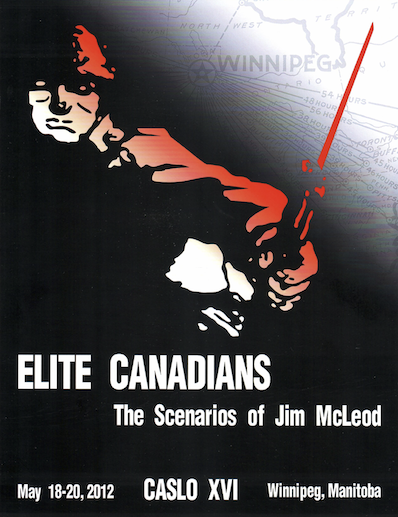
The eastern seaboard of North America has had its unfair share of bad luck this autumn. However, there were a few rays of sunshine during the calm before the storm. Steve Webber of Halifax, Nova Scotia was our high roller on 1 November. For rolling five sixes, Steve wins a copy of Elite Canadians. Published earlier this year, the scenario pack contains nine, full-colour scenarios designed by the late Jim McLeod. Three of these scenarios have not been published before. Fittingly, the Winnipeg ASL Club, of which Jim McLeod was a founding member, playtested and revised each of the designs. Congratulations Steve!
The winner of our October raffle had no competition.40 Keith Hill of Woolwich, Maine was the only Squad Leader to Yahtzee with five aces! Keith is a big fan of Canada, and things Canadian. I also know that Keith has a soft spot for the Japanese. “Hana-Saku” is a scenario set in Hong Kong, on 19 December 1941. The Winnipeg Grenadiers in this all-infantry action are hard pressed to hold off the seasoned troops of the Imperial Japanese Army. I think that Keith will enjoy this scenario, and many others in his new copy of Elite Canadians. But to make it extra special, we are including a set of our 12.5mm Commonwealth BattleDice. With a precision, red maple leaf in hand, Keith cannot possibly lose as the Canadians. I pity the Japanese. Congratulations Keith!
 |
| New from Lone Canuck |
George Kelln released his latest historical scenario pack in October. Ozerekya Breakout is an unusual but welcome campaign game published by Lone Canuck. Unusual because players get to send Romanian assault pioneers against Red Marines in the western Caucasus. Welcome because it is a manageable campaign game that can be completed in a long weekend, or less, of play. This latest offering from the Canadian publisher contains a colour mapsheet, four scenarios, and historical rules for the scenarios and the campaign game. Ozereevka—as it is found on modern maps—is a small bay some 15 kilometres southwest of the port of Novorossiysk, on the Black Sea. The Soviet Black Sea Fleet landed marines along the beaches of this bay on 4 February 1943. Their immediate objective was the town of Glebovka and the surrounding hills. The Romanian and German forces stationed in the area had other plans.41
If you have not picked this pack up, I encourage you to do so. It is a bargain at $25. However, Brad Knoll, of Kingston, Ontario has just landed a copy for the bargain-basement price of free! Brad won our 1 December raffle with a low roll of six. No one tied his score, and no one rolled five sixes. So Brad gets it all.
 |
| Coming January 2013! |
All, in this case, means that Brad also receives a set of our forthcoming Axis Minor BattleDice. The 12.5mm Axes to Grind pack includes five dice, one for each Axis Minor state listed in chapter H of the ASL Rule Book. These East European states allied themselves with Germany in the hope of expanding their borders at the expense of their neighbours, and quite often each other. In this sense, each of these states had an axe to grind. Congratulations Brad!
Neva’ mind the Mayans
The world is not going to end because some Mayan mystic said so. What are you waiting for then? Join Sitrep as a Squad Leader today!
We have not finalized the prizes for our raffle on New Years. But we can assure you that there will be something comparable to last year’s prize pot. Our next raffle will take place on 1 January 2013. To qualify, you need to be following Sitrep as a Squad Leader as of 31 December. We recommend that you also subscribe to Sitrep. A subscription will ensure that you are notified when we publish a new post.
A Squad Leader receives one ballot for each raffle. In addition, all Squad Leaders who joined before 1 July 2012 receive a bonus ballot—a thank you for joining early. Finally, all Squad Leaders displaying their full names (first and last), and a non-generic avatar receive a bonus ballot.
Good luck in the New Year!
How to claim a prize
To claim a prize, add a comment at the bottom of the appropriate post and email your contact details to us at: battleschool @ rogers dot com
Notes
1. According to established international conventions of the time, francs-tireurs were considered unlawful combatants and subject to summary execution without trial. This convention remained in force until 1949. From Wiki: Article 4 of the Third Geneva Convention (1949) states that irregular forces are entitled to prisoner of war status provided that they are commanded by a person responsible for his subordinates, have a fixed distinctive sign recognizable at a distance, carry arms openly, and conduct their operations in accordance with the laws and customs of war. If they do not do meet all of these, they may be considered francs-tireurs (in the original sense of “illegal combatant”) and punished as criminals in a military jurisdiction, which may include summary execution.
Soldiers who are wearing uniforms of the opposing army after the start of combat may be considered illegal combatants and subject to summary execution. Many armies have performed this kind of false flag ruse in the past, including both German and US special forces in WWII. However, if soldiers remove their disguises and put on proper insignia before the start of combat in such an operation, they are considered legal combatants and must be treated as prisoners-of-war if captured. This distinction was settled in the post-WWII trial of Otto Skorzeny, who led Operation Greif, an infiltration mission in which German commandos wore US uniforms to infiltrate US lines but removed them before actual combat.
2. Some maquis, or partisans, joined the Résistance in 1943 simply to avoid being drafted as forced labour for German industry.
3. One famous member of Franc-Tireur was the historian Marc Léopold Benjamin Bloch (1886-1944). Bloch was a native Lyonnais of Jewish parentage. During the Great War, he served in the infantry, and rose to the rank of capitaine. He won the Croix de guerre for gallantry, and was later awarded the Légion d’honneur. He is one of Europe’s more famous historians, having cofounded, with fellow French historian Lucien Febvre, the Annales School of history—after the journal that the pair founded: Annales d’histoire economique et sociale. [Bloch’s The Historian’s Craft was required reading for students pursuing an honours degree in history when I was an undergraduate. I still have the highlighted readings from my historiography seminar.]
I found an interesting anecdote about how Bloch faced death. Bloch had been captured by the Germans, and interrogated, along with other members of the Resistance. On 16 June 1944, he and a group of partisans were taken to a field near Saint-Didier-de-Formans to be shot. Bloch was a few weeks away from his 58th birthday. Beside him cringed a 16 year old partisan. The boy was understandably terrified. When the firing party cocked its weapons, the boy whimpered, “This is going to hurt.” “No, my boy,” the bespectacled man countered, “it doesn’t hurt.” Bloch then took the boy’s hands and held them, as shouted “Vive la France!” The story was apparently related by two survivors of the shooting. Whether true or not, France lost part of its history, and part of its future, with the death of these two francs-tireurs.
 |
| Marc Bloch at war |
4. Claude Esmin, “Street Combat: Soviet Urban Combat Tactics in Berlin,” Tactiques 8 (l’Association des Stratèges Ludiques: June 1995). One must be careful not to make too much of this. The Berlin Wall had fallen some six years earlier. So it is unlikely that the members of the Le Cercle had ties to the KGB. That said, we cannot rule out the possibility that l’Association des Stratèges Ludiques—the successor of Le Cercle—had been approached by the Federal Security Service of the Russian Federation (FSB). It is interesting to note that the formation of the FSB in 1995 coincided with the publication of an entire issue of Tactiques dedicated to Soviet operations in Berlin.
5. Théophile Monnier served as the first editor, but eventually left in order to create the wargaming magazine Vae Victis. Béchennec replaced him as editor. Unfortunately, Tactiques ceased publication with it ninth issue, while Vae Victis continues to steam ahead after more than 100 issues!
6. For a chronicle of the literature of l’ASL, consult the work of Dr. Mark Pitcavage, an authority on extremist groups.
7. Philippe Naud and Jean Devaux, “Débuter à ASL: N’ayez plus peur du monstre!” in Vae Victis 21 (Paris: Jul-Aug 1998). Laurent Cunin was another known associate specializing in the Provence region of southern France.
8. Another area of contention is whether or not Le Franc Tireur under M. X is the same organization. One version of events claims that M. X appropriated the name of the group for his own purposes. Another version claims that Closier had already dissolved the group when M. X approached him. Upon hearing M. X’s plans for a global société (association), Closier offered his support. The former chef also suggested that the new group use the already established (and historic) name Le Franc-Tireur.
9. Sylvain Ferreira was another frequent contributor and supporter of Tactiques. For a good overview of the history of this periodical refer link in endnote 7 above.
10. Indochine, or French Indochina comprised much of modern-day Vietnam, Cambodia, and Laos.
11. FT01 also underwent significant revisions before being republished in Journal 6 as J90 “The Time of Humiliations.” Closier capped this series of scenarios with FT08 “L’Ultime Traitrise.” “Ultimate Treachery,” as it appeared in Journal 4, takes place in Hanoi during March 1945. The action was one of many that occurred following the end of Tet. It was the result of a curious coexistence. In the aftermath of a number of sharp, small-scale engagements in September 1940, the Japanese had occupied Indochina. An agreement was reached whereby the French colonial administration agreed to a limited Japanese presence of 6000 soldiers, and transit rights for a further 19,000 troops. During this period, the French territorial army had remained cloistered in its military bases and border outposts. In early 1945, the future of the Japanese empire was in doubt, and an entire Japanese infantry division withdrew from China into Tonkin—the northern area of Indochina bordering China. The French Governor General protested the move, but took no other action. As tensions and uncertainty mounted, the Japanese decided to strike while they still had the initiative. What ensued was a number of disjointed, localized actions that caught French forces (although not the French intelligence services) by surprise.
12. In 2010, Bounding Fire Productions (BFP) published two scenarios featuring Thai in their massive Blood and Jungle scenario pack: BFP-37 “Debacle at Yeang Dang,” and BFP-46 “The Shan Capital.” BFP used Axis Minor counters to represent Thai forces, adding some interesting armored fighting vehicles (AFV) to the (BFP) counter mix.
13. Apart from the assistance of stalwart French ASL players the likes of Jean-Luc Béchennec and Laurent Forest, Laurent Closier was able to capitalize on the enthusiasm of Georges Tournemire. Known in some circles as Mr. T, Georges designed two scenarios for the third issue of LFT—one with the help of Bruno Vasquez.
14. The other five scenarios by Philippe Naud are J36 “The Bridge of Verdalsöra,” J37 “Tretten in Flames,” J41 “By Ourselves,” J44 “Audacity,” and J45 “The Last Roadblock.” See also Philippe Naud, “The Norwegian Campaign: The Germans Strike North,” pp. 3-5; “A Two Month Stint: the Chasseur de Podhale,” p. 10; and Laurent Closier, “The French Expeditionary Corps: ‘Victory’ at Narvik,” pp. 6-9, in ASL Journal 3 (Multi-Man Publishing: Millersville MD, 2001).
15. French marines, oddly enough, are part of the French army, not the navy. However, the marine at right is not afraid to get his feet wet.
16. ASL Annual 95 holds the record for sheer size at 96 pages. Journal 3 is to date the only MMP magazine to boast 80 pages.
I have long been bemused by the fact that French does not have a unique word for the number 80. I had attributed this to some sort of linguistic lassitude. Well it turns out that while quatre (four) and vingt (twenty) are derived from Latin, the French expression for eighty belies a Celtic origin. So blame the Celts for that particular lexicological idiosyncrasy.
In mathematics, a numbering system having 20 rather than 10 as its base is referred to as a vigesimal system, which explains why the French refer to eighty as four twenties. (Note the similarity to fourscore, an archaic expression for eighty.) The vigesimal system is far from the oddest numbering system, however. The Babylonian system was based on six. But the vestiges of a Celtic numbering convention sheds no light on why French (in France and Quebec) lacks a discreet word for seventy, or ninety for that matter. Soixante-dix, or sixty-ten, is a tedious way of expressing seventy. And do not get me started on quatre-vingt-dix! Perhaps this explains why the Walloons in Belgium, Francophone Swiss, seventy percent of the population of Val d’Aoste (northwest Italy), as well as the inhabitants of Jersey Island—the origin of my paternal ancestors—use septante, octante (or huitante in Switzerland), and nonante instead.
After all that explanation, LFT has once again broken the mould. Xavier recently announced that LFT 13 will be 100 pages long! At least the French have a word for one hundred. Oddly enough, my two cents are worth more than a cent. ;)
17. Hint: the list of contributors in From the Cellar 7 is a good place to start.
18. Those of you keeping count will have noticed that the numbering sequence of LFT scenarios excludes the scenarios of Laurent Cunin’s “Provence Pack” as “LFT 4 is more commonly known. Therefore, the first scenario in LFT 5 (FT13) follows the last scenario in LFT 3 (FT12).
19. English versions of the scenarios published in LFT 1 through LFT 3 were later published in Britain’s long running ASL newsletter View from the Trenches.
20. One scenario was a reprint (in French) of a large scenario entitled “Mourir à Madrid,” or “Dying in Madrid.” The scenario, which recreates some of the heavy fighting in the Spanish capital in November 1936, was designed by Omar Jeddaoui, and was published originally in the French gaming magazine Casus Belli. The ludicrous “Tea for Two” scenario, set in Tunisia, is another Jean «5+2» Devaux creation that speaks volumes about ASL humour. The effort required to translate the twelve scenario special rules (SSR) into English must have been considerable. The effort required to read them, is simply not worth it. That is, unless you are an ASL player. Disclaimer: some play testing required. Jean Devaux's “The Fugitive” was inspired by a photograph. Xavier Vitry remembered the afternoon where it all began. “It was a great afternoon with Jean. We had decided to playtest something,” Xavier recalled. “But after several 'banyuls' [a fortified red wine produced in the Pyrenees], [Jean] cooked some food, and we drank a full bottle of Madiran wine [another potent wine from southwest France]. We were quite toasted, and [upon] seeing that pic of the little dog, Jean told me: 'This pic really deserves a scenario!'”
21. A good “teaching” scenario involving only Infantry and support weapons (SW), I commend “Lenin’s Sons” to players of all experience levels. Each side faces a host of challenges during the game, which helps keep the action fluid. I played the scenario for perhaps the sixth or seventh time last month in Cleveland, Ohio. My superb opponent, Philippe Briaux of France, undoubtedly made the game that much memorable and entertaining. For the record, the meatiest offering in LFT 7—“The Porechye Bridgehead”—was reprinted in ASL Journal 6 in 2005.
 |
| Airboat circa 1920 |
22. The first Russian aerosani appeared in the 1920s. According to that much derided source Wikipedia, the first airboat was dubbed the Ugly Duckling. It was designed and built in 1905 in Nova Scotia, Canada by a team led by Dr. Alexander Graham Bell. In 1920, one of Dr. Bell protégés, Glenn Curtiss—the founder of Curtiss Aeroplane and Motor Company—reportedly registered the first airboat in Florida, in 1920. The forthcoming Finnish module will include aerosani in the counter mix. But as cool as they may be, the new module for the Pacific Theatre contains no airboats.
23. The only “official” scenarios were AP4 “L’Abbaye Blanche,” from Action Pack 1, and J6 “St. Barthelemy Bash,” a Deluxe-ASL scenario published in ASL Journal 1. I played AP4 for the first time in October 2012, but I have yet to give J6 a try.
24. The late Ian Daglish would have agreed. His massive J153 “Dawn’s Early Light” takes place on 7 August 1944, the opening day of Operation Lüttich, as the Germans referred to the Mortain counteroffensive. You will find the scenario in ASL Journal 10. Ian's design incorporates several disparate actions into a swirling combined-arms maelstrom. One portion of the scenario is reminiscent of the Bill Sisler's "L'Abbaye Blanche," published in Action Pack 1 in 1997. However, most of the action is new, and novel. For example, some SS infantry begin the game in Mortain, almost surrounded by hidden Americans of the 120th Infantry Regiment. Heaps of artillery, tanks, and infantry guarantee that both sides will have their hands full during the game. Can the Yanks stop the SS, or will German armour bull its way through the American defenses and exit for a win?
 |
| 116. PzD |
25. Surprisingly, scenario FT41 is the only scenario in LFT 8 involving American forces. The scenario stars the oft overlooked Panzergrenadiere of 116. Panzerdivision. The commander of this formation, General Gerhard von Schwerin, was vehemently opposed to the operation, and refused to cooperate. (Indeed, most German commanders believed that the counterattack had little chance of success.) After von Schwerin was relieved of command, his 60. Panzergrenadier Regiment went over to the attack. It was too late. In confused fighting north of St. Barthelemy, the 39th Infantry Regiment (US 35th Infantry Division) blunted, and in many cases, threw back the German thrust in this sector. However, one area of contention remained, the hamlet La Grand Mardelle. Overcommitted at this point, the commander of the US 35th ID requested assistance from the US 4th Infantry Division. And so it was that, on the afternoon of 8 August, elements of the German “Greyhound” Division clashed with elements of the US “Ivy” Division. Laurent’s scenario is doubly interesting because it is played on a portion of the map from the historical module Pegasus Bridge.
 |
| 4th US ID |
26. The scenarios were printed on flimsy, glossy paper (rather than cardstock), which understandably drew the ire of many LFT devotees. Subsequent printings of scenario cards in Cambodia have been on coated cardstock.
27. The sheet includes enough counters of Spanish infantry to play any of the scenarios in the magazine. An added bonus are the partially-armed, pre-1941 Fallschirmjäger counters. The Opportunity Fire and support weapon First Fire counters are a handy addition too.
28. “Das Untergang” also includes a Lett order of battle. The remnants of Lettish (Latvian) and Spanish Waffen SS units are caught up in the maelstrom of Berlin during the fall—solid late-war ASL action on board 45.
29. The Blue Division—known formally as 250. Infanterie-Division of the Wehrmacht—was formed in the summer of 1941 following a public outpouring of support for the German invasion of the Soviet Union. The division was a volunteer force divorced from the Spanish military. Its soldiers swore allegiance to Hitler and wore German uniforms during their service. The main concession to the uniform was a cloth shield worn on the right arm of their feldgrau tunics. The shield bore the red and gold of the Spanish flag surmounted by the word “España.” The division got its colourful label from the blue shirts of the Falangists, a fascist organization akin to Italy’s Blackshirts. Falangists flocked to the division, and many continued to wear their blue shirts under their German tunics.
 |
| Spanish Volunteer Medal |
For the most part, the Spaniards who volunteered to fight the Soviet Union viewed their participation as part of a wider crusade against Bolshevism. Many were veterans of the Spanish Civil War. From the perspective of these crusaders, Russia was culpable for prolonging the civil war in Spain. In an impassioned, impromptu speech on 24 June 1941, the Spanish Foreign Minister, Serrano Suñer, went further. “Russia is Guilty! Guilty of our Civil War. Guilty of the murder of [the founder of the Falange] José Antonia [Primo de Rivera],” he shouted to a massive crowd outside the Falangist headquarters in Madrid. Not surprisingly, some 3000 Spaniards continued to fight alongside Germany, long after the Spanish dictator, Generalísimo Francisco Franco, had ordered the last of his countrymen back to Spain. By the time the division was disbanded in October 1943, the Spanish volunteers had earned the admiration of their German comrades and Russian foes alike for their élan, steadfastness and courage in combat.
30. Other content included several historical articles germane to the period, an article on Gun Duels (C2.2401), a Solitaire ASL (SASL) campaign game centred on the US 1st Ranger Battalion at Anzio in January 1944, and much more. One scenario (FT95 “Raining Bullets”) involved a canal crossing with assault boats. Before you dismiss this scenario, have a look again at the applicable rules in E5. I played FT79 “First Blood” from LFT 10, which also involved an assault-boat crossing. We were surprised at how effortless the crossing was from a rules perspective.
31. Scenario A79 “Red Mike” was published in ASL Annual ‘95. Unfortunately, it did not make the cut when For King and Country was released. LFT used this scenario to illustrate a seaborne assault because of its size and because it included a mix of landing craft and Sherman Duplex Drive tanks. The author also thought that the counters would be easier to come by given that the both Pacific modules were long out of print. Do not fret if A79 is not in your collection. Everything you need [EXC: the rule book, especially chapter G] is contained within the article.
32. ASL Journal 9, published the following year, contains two more articles in this vein. Bret Hildebran’s “The Art of the Banzai” and Jim Bishop’s “The Science of Banzai” are required reading for budding fans of PTO. The latter article examines the mechanics of a Banzai Charge (G1.5), while the former provides advice on when to launch a charge, and conversely, how to counter one. If these do not satisfy your appetite for PTO fare, get a hold of Chas Smith’s 13-page “Pacific Terrain: the Law of the Jungle,” published in BFP3 Blood and Jungle, by Bounding Fire Productions in 2009.
33. Board LFT2 can mate with a standard geomorphic board along its longer sides. To my knowledge, this is the first ASL board that incorporates large expanses of Kunai—or grain if PTO Terrain (G.1) is not in effect—on a “hill” board. Unfortunately, boards LFT1 and LFT2 suffered from poor cutting, leaving some boards with extra “turf” along one of the longer sides. This was later remedied. (See also, Mark Pitcavages observations on his DM website.) LFT undoubtedly lost money because of this error. However, the publisher appears to have taken this setback in stride, as the cover of From the Cellar 5 suggests.
FT138 “Meeting up at Matan” is another ASL curiosity, the first that I have encountered where a gas attack has been incorporated into the scenario. Designer Jaen-Pascal Paoli has kept things mercifully uncomplicated. A simple SSR uses an artillery concentration of white phosphorous to replicate the presence of gas munitions during this Japanese attack on Chinese positions along the Yangste River in 1938. Elegant in its simplicity, Paoli’s SSR demonstrates how standard rules can be used to model the idiosyncrasies of the war in the Pacific.
34. This is a conservative figure based on Dave Ramsay’s wonderful resource, the ASL Scenario Archive.
35. A simplified version of the MGB rules are used in Heat of Battle’s Küstenjäger! Special Forces II: War in the Aegean Sea! I this scenario pack, Andrew Hershey collaborated with his American confrère Steve Swann, a veteran designer with a soft spot for special forces.
37. Out of Attic was a collection of previously published ASL articles and scenarios. There were 16 scenarios; all had identical artwork (right). I cannot speak for others, but I find the generic artwork uninspiring. It is a pity. There are some good scenarios in this publication, but I have never been inspired to play more than a couple. I wonder if they would receive more play if the scenarios had been accompanied by a scenario-specific drawing or photograph. The second issue was a big improvement over the first. Not only did each scenario feature a unique photograph, but some of the articles were also updated to reflect amendments to the rules.
38. Unbeknownst to the LFT staff, a few previously published scenarios crept into their third FTC pack. LFT had accepted the scenarios in good faith from an outside scenario designer. The revelation apparently caused a stir in some quarters. However, the reputation of the publisher does not appear to have suffered any lasting damage.
39. Most packs also contained a corrected version of board LFT2, which came with LFT 12. The three scenarios dealing with the Battle of La Horgne were: FT90 “Sans Esprit de Recul” by Hughes Pauget; FT148 “La Horgne” by Ian Daglish; and FT149 “Tombés pour la France” by Philippe Naud.
40. There was no September raffle because we were at ASLOk on 1 October.
41. I played a scenario from Ozerekya in November. It took me a while to get used to the idea of having an entire company of Romanian 5-3-7 assault engineers (H1.22) at my disposal. Not that they helped me against my skilled opponent.






.jpg)


