Showing posts with label Gröfaz. Show all posts

01 April 2012

Nordic Hour

Guess what the winner of our March raffle has won? 
Spring has arrived in the northern latitudes. The natives, restless for their place in the sun, are on the march. Who came blame them? It has been a long, grey winter. We have some colourful giveaways to welcome in the new season, in all its multihued splendour.
More than 170 Squad Leaders vied for prizes in our March raffle. Each Squad Leader received one roll of the dice for each month he or she had been following Sitrep. We went with just four dice this time. The person with the lowest sum of four dice would win. With so many Squad Leaders and so many rolls, we anticipated a few tie-breakers. Indeed, this proved the case. However, not for first place, but for second.
Not exactly counterproductive
Four contestants tied for second. Warrick resides in Hong Kong. You may know him as the fellow behind Countersmith Workshop, producer of player aids for ASL. Warrick placed fourth in the tiebreaker, with a roll of 17. However, like Joseph Ladd, one of Warrick's rolls totalled 24. For their “train wrecks,” Warrick and Joseph each receive a Sniper! Effects die and a $10.00 gift certificate for KitShop. 
Yockbo 
Third-place in the tie-breaker went to Martin Hicks, a past raffle winner. Martin bested Warrick with a 15, but was in turn edged out of a third-place finish by Stephen Brasseur. A long-time ASL player, Stephen games in Kirkwood, Missouri. Stephen plays a variety of boardgames. However, ASL remains a big part of his life. I think his custom dice tower below speaks volumes. 
You can find out more about Stephen by visiting his Yockbo's Boardgame Blog. If you happen to find out the story behind his nickname, be sure to let us know. 
It looks like Yockbo's ASL-themed dice tower could use some company. Indeed, it will not be long before some smart-looking precision dice make their way down that ASL dice tower. Stephen wins a Tommy Pack and a $10.00 gift certificate for KitShop.    
Concealed, but not hidden
Sadly, the runner-up of our March raffle remains concealed. Our mysterious SMC managed a sum of five, followed by thirteen in the tie-breaker, for second place over all. Should our runner-up step forward, he (or she) will receive a Sniper! Pack and a $10.00 gift certificate for KitShop. Had “tiohn” placed first, I am certain that we would witness a rapid and voluntarily drop of concealment in order to claim our (specious) grand prize for March. Speaking of which, it is time to announce the winner. 
ASL refugee
How many scenarios have you played where the game was won (or lost) on the last, or next to last dice roll? Not that this is a bad outcome. It is usually the sign of a good game. It certainly makes for an exciting finish. And so it was with our draw this month. 
For a change of pace, we began with the most recent Squad Leaders and worked back towards those who had joined in July 2011. It was not until September that the first “five” appeared. And only in July did the remaining “fives” appear. But still no pair of “snake eyes.” I was beginning to doubt that we would ever see four aces. 
With only one player left to roll for, I had to laugh. What a great story it would make, if this fellow rolled four ones on his last roll? It would have been a great story. Instead, it is just a very good story. On his fourth-to-last roll, he pulled it off! What makes this a good story is the fact that he was the first person to join Sitrep as a Squad Leader. What makes this a very good story is the fact that he is also the only player from outside the United States to ever win the Gröfaz title (in 2003) at the ASL Oktoberfest (ASLOK) Tournament in Cleveland, Ohio. I have to wonder, if luck was not a factor.
Aaron Cleavin is a top player. For some reason, he has been “ducking” me. But I can live with that. No need to get thoroughly diced by a Gröfaz. Last year, for instance, he played more than 160 scenarios. In 2010, he managed a whopping 185! The man is a machine. However, he is slightly off the pace so far this year, with a projected 155-170 for 2012. Good grief! Small wonder, Aaron is known as the “Cleavinator.”
The winning roll

We are kindred spirits, in a sense. He purportedly left his homeland of New Zealand as an “economic refugee.” (He may also have been an ASL refugee—opponents are hard to come by in New Zealand.) Aaron found work abroad, first in Japan, and later in Ireland, and finally in Australia. The irony is that I emigrated to New Zealand (from Canada) as an “economic refugee.” I too found work. Aaron also completed part of his MBA in Canada. Funny how things work out.
Being at the far end of the ASL supply chain, Aaron may have to wait a few weeks for his prize, but then he is used to waiting a little longer for his ASL fix. He lives in Sydney, Australia. However, distance is no barrier to Aaron. He has been to ASLOK at least nine times since 1996, and plans to attend this year. Congratulations Aaron on another “international win!” Aarons wins... Well you know what he wins. But first, a word from our “sponsors.”
Youse Call
A brief word about Hakkaa Päälle. Depending upon your temperament, the release of this module may not be a top, personal priority. I am biased. Late in the play-test process, I lent a hand and liked what I saw. 
If I had anything negative to say about the new module, it may have been related to the fact that it comes with only one board (52). But that is not an issue because the scenarios in the module make the most of other boards in the system. No, what seems to have irked some detractors is the prospect of the Finns being released in the same grey palette found in the third edition of Beyond Valor. 
Fear not, all is well is the hallowed halls of Multi-Man Publishing (MMP). I have it on good authority that there will be a new Finnish colour scheme. I must say that I am impressed. “MMP brought some real innovations to the table with our Pegasus Bridge module back in '97,” Brian Youse told me. “The Ox and Bucks were cool, but the Pegasus counters stole the show,” he added. The breakthrough came during a brainstorming session held at the Winter Offensive Tournament this past January. The MMP team decided to go one better than a simple colour change for the reworked Finns. I love the new look. Sorry, no sneak peek. Brian asked that I keep it under my hat until the module goes up for pre-order on Monday.1
Make your own luck
Trent Dobbs joined Sitrep on 28 March. Although granted a single roll for the raffle, he nonetheless posted a respectable nine where the mean roll was roughly fourteen. It is never too late join Sitrep as a Squad Leader. However, the sooner you join, the greater your odds of winning.
Next month we will be raffling off a copy of Swedish Volunteers, second edition. The Molotov counters in this new edition are an absolut must have. The “module” includes two new scenarios: Hansson Hijinks, and Cocktail Hour. The first marks the debut of a political agitator of the same name. The second, my favourite, features the Swedish version of the Flaming Dutchman.2 If you do not already own them, you need to add these Axis Miners [sic] to your ASL order of battle.
I am happy to announce that BattleSchool will be the exclusive North American distributor of Swedish Volunteers. Many of you will be happy to hear that the North American version will be available in Letter rather than A4 format.3
Finally, a reminder that we will be raffling off a copy of Festung Budapest on Canada Day. In addition, Sitrep Squad Leaders (followers) will have an opportunity to win a set of custom, precision Festung Budapest BattleDice. To qualify for this special raffle, Squad Leaders must be following Sitrep under their full names (first and last). Each qualifying Squad Leader will receive one ballot for the raffle. Followers with a custom avatar will receive a second ballot. Finally, followers displaying a portrait of themselves will receive a third ballot. Good luck to everyone in the next raffle. Thanks for reading.
Part of the Festung Budapest BattleDice set
Notes
1. This entire paragraph is a load of codswallup, whatever that means. But we can still dream.
From Wikipedia: In 1872, British soft drink maker Hiram Codd of Camberwell, London, designed and patented a bottle designed specifically for carbonated drinks. The Codd-neck bottle was designed and manufactured to enclose a marble and a rubber washer/gasket in the neck. The bottles were filled upside down, and pressure of the gas in the bottle forced the marble against the washer, sealing in the carbonation. The bottle was pinched into a special shape, as can be seen in the photo to the left, to provide a chamber into which the marble was pushed to open the bottle. This prevented the marble from blocking the neck as the drink was poured.
Soon after its introduction, the bottle became extremely popular with the soft drink and brewing industries mainly in Europe, Asia and Australasia, though some alcohol drinkers disdained the use of the bottle. One etymology of the term codswallop originates from beer sold in Codd bottles, though this is generally dismissed as a folk etymology.
The bottles were regularly produced for many decades, but gradually declined in usage. Since children smashed the bottles to retrieve the marbles, they are relatively rare and have become collector items; particularly in the UK. A cobalt coloured Codd bottle today may fetch thousands of British pounds at auction. The Codd-neck design is still used for the Japanese soft drink Ramune and the Indian drink Banta.
2. A Flaming Dutchman is a potent elixir of cognac, sherry, gin, lemon juice, and bitters. It culminates in a douse of lemon juice sprayed over an open flame. Sharp and tangy, the cocktail is prone to flame creation in your Location at the slightest misstep. Best consumed outdoors, and away from flammable terrain.
3. Except for the Flaming Dutchman cocktail, this paragraph, and the one that precedes it, are a work of April fiction. Your first clue was the misspelling of "absolute." I used the vodka brand name, albeit without an uppercase "A." Hansson was the second clue, although I expected this would be picked up by only a handful of historically-minded Swedes. Per Albin Hansson was the Swedish Prime Minister during the Second World War.
163. Inf-Div
During the so-called Midsummer Crisis of 1941, Hansson's government granted permission for the German 163rd Infantry Division—locks, stocks, and barrels—to transit Swedish territory. The German division was stationed in Norway at the time. The Wehrmacht shifted the formation east to Finland, along Swedish rail lines. General Erwin Engelbrecht's division was initially subordinated to the Finnish military in order to support operations against the Soviet Union. In early 1942, the division came under German command. The formation remained in Finland until autumn 1944, when it returned to Norway. The division was destroyed in March 1945, while combatting Soviet forces in Pomerania.
Before becoming Prime Minister, Hansson served as the Swedish Defence Minister. This was a curious career move for someone with a reputation as an anti-militarist agitator. However, the Swedish communists were on to him decades earlier, as the cartoon above illustrates. In 1911, he argued that spending 65 million on the military was too much. When Defence Minister in 1925, he argued that 107 million was required in order to ensure that Sweden had the ability to respond rapidly to threats. By the time he was Prime Minister in 1927, Hansson was telling the electorate that 139 million was not too much to spend on defence. 
UPDATE: MMP has announced that they will publish an updated, and possibly expanded, edition of Swedish Volunteers. No word yet on how it will be published (i.e. as a scenario pack, as part of a magazine, etc.). However, the "module" will be formatted on letter (8.5" x 11"). Coincidence? Must be. ;)
4. This remains true. We will raffle off a copy of Festung Budapest on Canada Day, 2012.


Gröfaz for a Gröfaz
I first met Aaron, along with fellow Kiwi expatriate Pete Palmer, at ASLOK in 2010. Both took a punt on our newfangled BattleDice. Pete used his dice to spectacular effect against Gary Fortenberry, among others. This may have prompted Gary to have a closer look at these dastardly dice. Thanks Pete! But it was Aaron who first discovered that even more spectacular results were possible. He later demonstrated how one of his dice had become cocked in the oddest of ways. I took the picture of the blue Gröfaz Ritterkreuz die above this weekend. It is neither affixed to the tray, nor propped up in any way. While it is certainly possible for one of these large dice to come to rest in this manner, I have yet to witness it during play.
We only had 20 Gröfaz sets of our ASL Anniversary BattleDice made. My thinking was that past Gröfaz champions would be interested in owing an exclusive set of dice. However, to date, there are fewer than 20 people who hold this esteemed title. Aaron told me at the time that if I had any business integrity, I would only offer these for sale to bona fide Gröfaz. But what were we to do with the remainder? I countered that we had reserved a set of Gröfaz dice for each past champion. We had also donated a set for the would-be champion in 2010. (We did the same in 2011.)
Last year was a bit of a patch bad for Aaron. Like others elsewhere, he lost his job, and missed ASLOK. He also missed an opportunity to compete for a set of Gröfaz American and Commonwealth BattleDice. The dice were specially designed to commemorate the 25th anniversary of the ASLOK tournament. Fortunately, we still have "Aaron's set" in stock.
It is our pleasure to award Aaron a Gröfaz set of our ASLOK Anniversary BattleDice. Granted he did not win this set on the field of battle. However, he did win our March raffle fair and square. There is a catch, however. Aaron routinely records upwards of 150 games a year. Even steel dice would begin to show wear under that much use. Therefore, we reserve the right to void the “warranty” on these dice if play exceeds 100 games per year. We hope Aaron understands.
Does Aaron get a copy of Hakkaa Päälle when it is released, you ask? Are you kidding me? 


It's April Fools' Day!

To claim a prize, simply leave a comment at the end of this post, and send us an email: battleschool @ rogers dot com

05 March 2012

Shortchanged?


Helen had an idea. She had watched me play the first round of my VASLeague match.1 For those who have yet to experience the pleasures of Virtual ASL (VASL), you are shortchanging yourselves.
Rodney Kinney’s ASL interface is a fantastic way to get a game in with a friend from out of town, or ‘round the other side of the planet, for that matter. VASL also takes a lot of the fiddliness out of a game. For instance, it takes little effort to customize the playing area with virtual overlays. I cannot speak for you, but it is sometimes a mission for me just to find a particular overlay amongst my kit. Clean up is also a snap; no counters to put away (or tip over). The program will even roll dice at the click of a button. And here is where Helen came in.
“Hey, that’s cool,” she said. “Why don’t we use that dice thingee for the next raffle?”
So that's why they call them tumblers
Now, she never did say that. Even a “newbie” knows where to draw the line. But for those of you who have yet to experience the displeasures of the VASL “dicebot,” you lucky ß@§‡∆®₫$! The truth is there are a lot of people who are skeptical about the randomness of the VASL 'bot. Not to worry, the best minds are developing a workaround as I write.
In the meantime, we will continue to roll bones the old school way. But boy, oh boy, what a lot of rolling. About 170 Squad Leaders were entered in our February raffle. My thinking was that we could reduce the number of potential ties by using seven dice for the contest. Do not try this at home! Getting your mitts around seven cubes, even the half-inch variety, is a challenge. Keeping the little devils in the tray after they tumbled down the tower was another worry. Happily, it all worked out in the end. 
A matter of perspective
With seven dice the highest possible roll is forty-two. Only one contestant came close. From his perspective in Wellington, New Zealand, he rolled extremely well: a pair of deuces and five aces. But as unfair as it may seem, we were only concerned with the pips that were facing up, and there were forty of them! The roll was nevertheless remarkable, the “equivalent” of rolling a nine with seven dice. Considering that no one had a roll below eleven, we felt that forty-two was worthy of a little recognition. 
Coincidentally, each of the biographical  sketches that follow have a Canadian connection. Most are obvious. Such is the case with Dale Drake. In 1995, Dale was a trooper with Queen Alexandra's Mounted Rifles, light cavalry with a partial infantry role. His high school days were still fresh in his mind, but his surroundings were completely foreign. Dale was in Bosnia, attached to a rifle company of the 2/1 New Zealand Infantry Regiment. However, one of Dale's fondest memories is of an exchange with the 3rd Battalion, The Royal Canadian Regiment in Visoko and Ilijaš, or as he put it: “a hostage from CanBatt 2.”2 
Dale has had no success finding local opponents in Wellington. This is troubling as Wellington used to have a thriving ASL community. Dale is getting desperate. He is threatening to draft his sons, if he cannot find a local opponent. Is there anyone out there? 
Dale joined Sitrep shortly before Xmas. He may be shortchanged with respect to local “oppos.” However, he is not entirely out of luck. Dale wins a Heretical Rate of Fire die for rolling an “upside-down” nine.  
Stay calm and carry on
The second lowest sum was twelve. Two contestants shared this result. Andy Beaton was one of them. 
I first met Andy online through the VASLeague in May 2010. He lives in the Greater Toronto Area (GTA). We played “Failure to Communicate” from the first Winter Offensive Bonus Pack. His French 10-2 leader gave my Germans a tough time. However, it was a plucky 8-0 with a demolition charge that won him the game when he took out one of my remaining tin cans and nudged me over the casualty cap. 
Andy has long been an enthusiastic supporter of our hobby. He can be seen at left coaching a first timer through a Starter Kit scenario at a game convention in the GTA. Last October, he made the pilgrimage to Cleveland. Although it was his first ASL Oktoberfest (ASLOK), he played well, making it to the finals of the desert mini-tournament. He and Doug Sheppard played the classic “Khamsin” from West of Alamein. Doug is a top player and past Desert Mini champ. It is a testament to Andy's dogged perseverance that the game came down to the very end. Doug commented afterward that it was the most memorable desert scenario that he had played in years. 

My match with Andy that same week was entirely forgettable. I was too aggressive. Lesson learned (again). Never ever underestimate Andy's ability to wrest the initiative from you with a low-odds countermove. Truth is, I did not put the same effort into the game as Andy did. To get the most of a game, I recommend that you follow Andy's lead. Put your heart into the game, keep your focus, and do not give up.
Andy wins a copy of the latest Friendly Fire scenario pack, and a Heretical Rate of Fire die.
Band of Odders 
When Sitrep launched last July, most of our readers hailed from the United States and Canada. To my surprise, the third largest contingent was from Spain. Even today, Spain ranks in the top ten, slightly below Germany, but still slightly ahead of Australia. Needless to say, I was pleased to see that one of our Iberian Squad Leaders had been shortlisted in our February raffle. Moreover, he did so in style. 
Martí Cabré can hardly claim to have been shortchanged. The average sum was 24. Martí scored a dozen twice!
Martí's love of ASL is eclipsed only by his love for his native Catalonia, and perhaps his belle. Martí lives in Terrassa (Tarrasa, in Spanish), less than 30 kilometres from Barcelona. Those who frequent BoardGameGeek and the ASL Forums on GameSquad may recognize his avatar. However, like me, you may have wondered what it was. Turns out it is the coat of arms of Pere II el Catòlic, King of Aragón (1196-1213), and the former Count of Barcelona (Pere I). Who knew? The Catalan flag that Martí keeps in his sitting room sports the same red stripes on gold field emblazoned on the shield of Peter the Catholic.3 Mystery solved. 

Martí is Catalonia's ambassador of ASL. He has a wide circle of gaming friends, many of whom play other board games, or with miniatures. Tapping into this network, Martí has been able to coax a few gamers along the path to ASL Starter Kit. Some like Jordi in the picture above, are progressing quite nicely. But Martí's recruiting drives are more ambitious. 
Since 2007, Martí has been posting about boardgames on his blog Band of Odders. His inaugural post was followed by a write up of S11 “A Long Way to Go.” But what makes his blog special is that it is written in Catalan. This is an important development for our hobby. While there is a Catalan Wargamers Resource website, it does not appear to have any ASL content. There are some nine million Catalan speakers in the world. Most reside in Spain. However, Catalan speakers also can be found in Andorra, France and Sardinia (Italy). Learning a new language is tough enough. Learning English and the ASL Rule Book is something else altogether. I therefore applaud Martí's efforts to acquaint more people with ASL. 
Last November, a small but enthusiastic group of ASL players gathered in Barcelona for the 13th Fanatic Tournament. In the thick of it was our Catalan ambassador Martí Cabré. Due to the theme of the tournament, players had a chance to play a unique scenario starring a few Canadians. I say unique, because to my knowledge there are only two scenarios where Canadians face the Imperial Japanese Army. They are: MLR1 “Hana-Saku,” and FE130 “Desperate Straights.” I have yet to play either scenario. It is high time that I did. 
For spreading the good word in Catalan, and for rolling low, Martí wins a copy of the lastest Winter Offensive Bonus Pack, a Heretical Rate of Fire die, and a $10.00 gift certificate for our KitShop. Felicitats Martí!
House call
The winner of our February raffle is a mild-mannered fellow from Berlin. He has attended the last two Canadian ASL Open (CASLO) tournaments in Ottawa. Yet, I have not had the pleasure of playing him. It turns out that we have a mutual ASL friend, a Circassian who moved to Canada some time ago. I only learned of this in 2010, and then only when I made a point of asking him who the cross-border player was. 

Circassians originated in the northern Caucasus, but many later settled in the Levant (present day Israel, Jordan, Lebanon, and Syria) during the Circassian diaspora in the 19th century. To paraphrase Dennis Hopper from the film True Romance, this stuff fascinates me.4 I studied the history of the Near East (Middle East) a fair bit in university. I also did a tour in the Golan Heights in 1985-86. As an interesting aside, during the 1930s, Circassians living in al-Quneitra approached officials of the then French Mandate. They lobbied for an independent Circassian state on the Golan Heights. They based their case on the fact that they constituted the majority in al-Quneitra, the largest settlement on the Golan. I spent six months in Camp Ziouani, just outside the ruined town of al-Quneitra. It would be another ten years before I learned that there were Circassians living in the Middle East. So where am I going with this? To Brockville, naturally, as that is where our mutual friend lives.  
Brockville is less than an hour drive from my place. I have played three or four face-to-face games with Dana over the years, but not of late. So imagine my surprise when the winner of this month's raffle winner told me that in 2010 he had made a house call in Brockville. He was on his way to the CASLO, and had arranged to hook up with his old ASL buddy. But what surprised me the most was that Dana was responsible for getting "Doc" Evans into the hobby. 

Mark Evans is an acupuncturist in Berlin, New Hampshire. He is also a pretty decent player. He placed third at the CASLO last year.5 To be clear, this had nothing to do with his standing offer of complimentary therapy for all the CASLO attendees. No, he won fair and square. He also won our February raffle outright with an 11, and a 13! 
Mark wins a copy of Le Franc Tireur's latest scenario pack From the Cellar 6, a Sniper! Effects die, and a $20.00 gift certificate for our KitShop. Congratulations Mark!
Make your own luck
It is never too late to become a Squad Leader. Jonathan K. joined on 31 December. His lowest sum was 13. And Fred Ingram, who joined the same month, had two rolls of 16! Suffice it to say that one roll of the dice is one more than none. Make your own luck and join Sitrep as a Squad Leader (follower) today!


To claim a prize, simply leave a comment at the end of this post, and send us an email: battleschool @ rogers dot com


Acknowledgements and Notes
The cellar rat appears courtesy of Le Franc Tireur, publishers of stunning, full-colour ASL scenario packs, magazines, and historical modules. 
1. The VASLeague turned six this year. Enrico Catanzaro of Palermo, Sicily is the Tournament Director and chief whip. There are several Minor Leagues (Europe, Australasia, Eastern North/South America, and Central/Western North/South America), and one Major League. Players are promoted to the majors each year. This new blood is used to replace low-ranking individuals in the majors, as well as those who decline to continue for another year. The minors are grouped roughly according to time zones thereby allowing players to play in real time on VASL. Play-by-email (PBEM) is also permitted, but the default method is live VASL. For more information, see Enrico's post on BoardGameGeek.
2. Initially, the New Zealand company was attached to a British infantry battalion—Royal Highland Fusiliers—for administrative purposes. Dale's reference to being a “hostage” is not accidental. During 1995, 55 members of ‘A’ Squadron, Royal Canadian Dragoons—part of Canadian Battalion 2—were taken hostage by Serb forces. According to some reports, the hostages were treated well by the Serbs, while their comrades back in Visoko were mortared and rocketed. However, Dale received nothing less than the royal treatment from his Canadian hosts. Keen to see what a “treadhead” was made of, “Rocky,” the RCR section commander, assigned Dale a C9 Light-machinegun. Dale also insists that some visiting Canadians helped him and his mates drink the Kiwi canteen dry later in the tour. That's odd. Most of the guys who I served with in the army were strict teetotalers. <wink>
3. According to legend, the arms of Aragón were originally plain gold, or “Or plain.” The changed purportedly occurred following the death in battle of Geoffroy le Velu, King of Aragón. Geoffroy had been fighting alongside Charles le Chauve against the Normans. In a dramatic show of gratitude for Geoffroy's bravery, Charles dipped his fingers in his blood and smeared them onto the shield. The four red fingers, or in heraldic terms, the “four pallets gules,” thereafter adorned the “Or plain.”
Pere/Pedro/Peter II (1174-1213) gained prestige and lasting fame for his role in the Battle of Las Navas de Tolosa (16 July 1212). The battle took place some 250 kilometres south of Madrid. Known in Arab history as the Battle of Al-Uqab, the defeat of the Moors at Las Navas de Tolosa was a major turning point in the Reconquista of the Iberian peninsula. Ironically, Peter died only a year later at the battle of Muret, while fighting fellow Crusaders.
4. If you love flicks with brilliant dialogue, you need to watch this one. To my knowledge, it is the first screenplay written by Quentin Tarantino. The cast is top notch. Gary Oldman is a superb slimeball. This is also where the seed for The Soprano's was sown.
5. Rather than spoil the CASLO After-Action Report due to be published after the Festung Budapest post, I will save the details of Mark's accomplishments at the CASLO until then.

06 November 2011

Crossed Purposes?


This year marked the 25th anniversary of the largest and longest-running ASL tournament anywhere. ASL Oktoberfest, or ASLOK for short, originated in Youngstown, Ohio. In 1986, Bill “Fish” Conner and Darryl “Action Burk” Burk held their first tourney. Seventeen enthusiasts attended. As time passed, the event grew up and left home, drawn to the bright lights of Cleveland. Today, ASLOK is the most significant event on the ASL calendar.1 
One hundred and sixty-three people registered for ASLOK this year. While not a record, attendance was well above the median of 134. In its second year, ASLOK drew 47 people for what was then a weekend tourney.  Attendance climbed to 85 the next year, and to 95 the year after. From 1990 onward, registration has never fallen below 100. From its humble beginnings as a regional event, ASLOK has morphed into a ten-day international festival. No other tournament has come close to matching the magnitude of Oktoberfest. 
Silver jubilee
Perhaps the most impressive thing about ASLOK is its longevity. A handful of regional and national tournaments have been around for 15 years or so. None, to my knowledge, have surpassed the 20-year mark. ASLOK is the only exception. Twenty-five years is a long run for any tournament, let alone one devoted exclusively to ASL. For this reason, as well as more selfish ones, I thought that this particular ASLOK milestone was worthy of commemoration. More to the point, I felt that this memorable occasion would be more memorable if I created a set of precision dice to mark the occasion. 
Last year I designed a set of German and Russian BattleDice to commemorate the 25th anniversary of ASL. The silver anniversary of Oktoberfest presented me with an opportunity to build upon this earlier work by adding a couple more nationalities to the dice mix. The German and Russian set had proven quite popular. However, the set also raised expectations. Would I be making an American set, how about the Japanese, or had I considered...?” I was not opposed to the idea of creating dice for each major nationality in ASL. At the same time, I had not contemplated producing additional dice with the same level of detail found on the ASL Anniversary set. In other words, although I was comfortable with the prospect of creating a line of smaller dice featuring basic national symbols, it had never been my intention to create an entire line of dice festooned with elaborate graphics.  
Notwithstanding this, I had established a pattern with my German and Russian BattleDice set. Each nationality pair would feature a medal on the ace of the coloured die, and a soldier on the corresponding spot of the white die. I had already set aside green for the Americans and amber for the British Commonwealth. Designing the ASLOK set should have been a simple matter of inserting new graphics into this template. It was not. I was conscious of several problems before I started. In the end, some of the designs proved far more difficult than I had anticipated. Throughout the design process, that forgettable Sesame Street ditty taunted me: “One of these things is not like the other...” What follows are my rationalizations for the final designs of the ASLOK Anniversary set.
The natural order of things
My first anniversary set was a nostalgic nod to Squad Leader (SL). The German on the lid of the SL box is an enduring reminder of the roots and the evolution of our hobby. It is not for nothing that this iconic German squad leader continues to feature prominently on the cover of the ASL Rule Book.2 The Russian officer, snatched from the cover of Cross of Iron, reinforced the SL legacy. It stood to reason that I would draw upon the last two gamettes in the SL series for my next project. That was in fact the plan.
As plans go, it began well enough. I modelled one of the white dice on the steadfast corporal of Crescendo of Doom fame. I was unable to track down a copy of the original photograph. Fortunately, Rob McGowan’s artwork contained more than enough detail for my purposes. Of the four designs, the British corporal required the least work—about a day.3 The nature of the design was such that it also provided the broadest canvas for the placement of text. He remains my favourite. The American soldier was another matter.
General Issues
Why an American, and not an Italian? After all, the first set of dice was a study in contrasts: German versus Russian; Axis versus Allies. Honestly, it never occurred to me to square the British corporal off with an Axis rival.4 In keeping with the title, the cover of G.I. Anvil of Victory had an obvious American theme. And given that GI was the fourth and final installment of the SL series, it seemed appropriate that my fourth nationality pair would be an American one. 
Original (rejected) artwork
It also made sense from an ASL perspective. The first core module, Beyond Valor, contains the bulk of the German and Russian orders of battle. The next two core modules add the Americans (Yanks) and the British Commonwealth (For King and Country).5 I have not done the math, but I would contend that the majority of ASL scenarios use one or more of these general “nationalities.” In light of this, I felt that American and British dice would see almost as much use as the German and Russian dice would.

The difficulty arose when I tried to use the lieutenant on the cover of GI. The outstretched arm and leg made for an awkward design. I would either have to chop off part of each limb, or settle for a tiny, almost unrecognizable image on the face of the die. Neither prospect appealed to me. So off I went in search of an alternative. I did not have to venture far. 
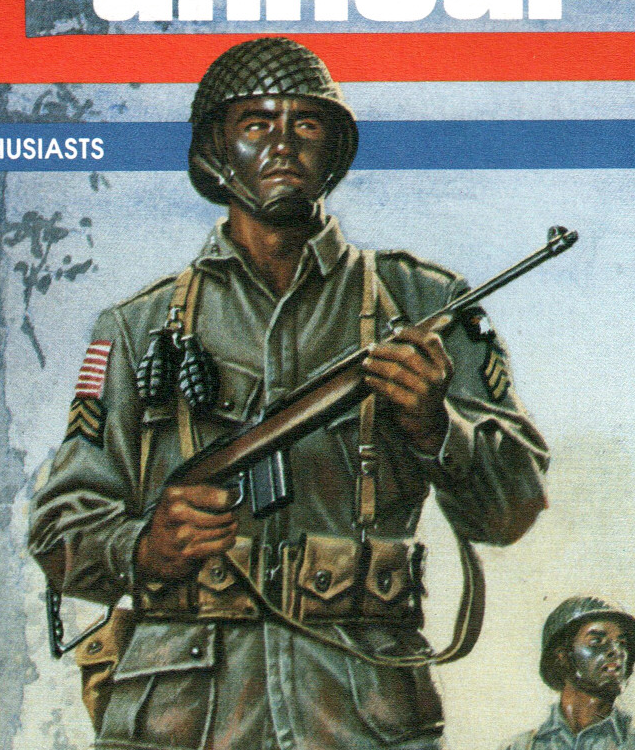
Yanks did nothing for me. But the cover of the Paratrooper module worked on a number of levels. It had an interesting subject, a sergeant of the 101st Airborne Division, the famous Screaming Eagles. Paratrooper provided a convenient segue from SL to ASL. Avalon Hill published the module in order to assist/entice SL players contemplating the transition from SL to ASL. Except for the ASL Rule Book, Paratrooper was largely self contained, requiring only the four original boards from SL to play. Finally, Bill Conner, one of the founders of ASLOK, was a former ‘trooper—in the 82nd All-American, if memory serves me. 
The sergeant still required some work. His blackened face had to go, as it would “muddy” the image at scale. I was loath to remove the grenades and kept them even though they are barely visible on the finished die. The netting on the helmet—Helen’s favourite detail—turned out surprisingly well considering the scale. (Photographs do not do it justice.) But for the most part I had to reduce the amount of overall detail drastically. I must have redone the drawing more than 20 times. Consequently, the paratrooper was the most labour intensive of the four graphics. But it was not the only graphic to require a lot of work.
The trouble with medals
Deciding upon which military medals to pair with my American and British squad leaders should have been a snap. The German and Russian set suggested to many observers that I would use the most prestigious, or highest, American and British military decorations in my designs. I may as well set the record straight. 
Medal of Courage
Where military orders are concerned, the Knight’s Cross with Oak Leaves is a mid grade order of the Iron Cross. There are five grades above it, one of which was never awarded. As I explained in an earlier post, I used this particular grade of the award because it looked the most interesting at scale. The Hero of the Soviet Union is not a military order, but rather an honourary title bestowed upon civilian and military personal for heroic deeds in the service of the Soviet state and society.
Order of Glory
The highest Soviet military order during World War II was the Order of Victory. It was reserved for generals and marshals. The highest medal awarded to a soldier for bravery in battle was the Medal of Courage. Over four million were awarded. The Order of Glory, awarded to non-commissioned army personnel for bravery in the face of the enemy, was less common. Roughly 2,600 soldiers received the First Class of this Order. In retrospect, the Order of Glory may have worked for the Russian set, although the T-35 on the Medal of Courage beckons even now. But in my defence, I still feel that the Hero of the Soviet Union works best. The gold star has good contrast, while the red colour of the die does double duty as the “ribbon” of the decoration. 
Therefore, when it came to selecting medals for the ASLOK set, I did not feel constrained by any particular  precedent, other than using medals, I suppose. Unfortunately, my options, where medals were concerned, proved more limited than I had imagined. The top three candidates for the American die are shown below.
Medal of Honor, Distinguished Service Cross, and Silver Star
The "Gillespie"
I had ruled out the Medal of Honor (MOH) early on. During the war, the US Army had used two different designs: the Gillespie (1904-44), and the current version above. The other difficulty was that the Marine Corps shared the Navy version of the medal. Additionally, some Americans are sensitive about how and where the medal is displayed, and for what purpose. Until 2006, it was illegal to reproduce or sell the medal—some transgressors have paid stiff fines or gone to jail for doing so. However, for my purposes, the MOH was simply too complex a design to replicate well on a die, especially the star-speckled ribbon. 

Military Cross
I initially turned to the Silver Star, which oddly enough, is not silver, save a tiny central star. The Star is not very elaborate, and thus was a good candidate. I even considered cutting out the central silver star so that the green of the coloured die would radiate from the centre. The trouble is that the comparable British medal was actually two medals: the Military Cross (MC), and the Military Medal (MM).6 The former was reserved for junior officers and warrant officers, the latter for the lower ranks. US decorations for bravery make no such distinctions. 
DCM
I had the same problem with the second highest US award for gallantry. The Distinguished Service Cross (DSC) was awarded to soldiers of any rank “for extreme gallantry and risk of life in actual combat with an armed enemy force.” The British equivalent for officers—usually above the rank of Captain—was the Distinguished Service Order (DSO), and for other ranks, the Distinguished Conduct Medal (DCM).7 Moreover, the DSO often was awarded for inspired leadership rather than gallantry per se. The DSC nevertheless had its appeal—at least from a design point of view. 
Photo of DSC
The DSC is fashioned in bronze, which gives the medal a certain understated dignity. The design is not very elaborate either. It features a bald eagle, the national bird of the United States since 1782, and a small scroll with the words “FOR VALOR.” Now work with me for a moment. Remove the eagle, and replace it with a lion. Modify the shape of the cross a bit, and add a “u” to the scroll. Et voilà: a Victoria Cross (VC)—the supreme award for gallantry across the British Commonwealth. 


VC awarded during the Boer War 


I admit that the DSC and the VC are not equivalent awards, but they do have a lot in common. Both are bronze, both feature iconic national or imperial symbols, both are awarded for valour, both are crosses, and neither award discriminates on the basis of rank. The VC is also a good fit because, unlike the MM and the DCM, which some members of the British Commonwealth were not entitled to, the VC could be won by any subject of the British empire. That is how I came to choose a DSC and a VC for the ASLOK set.
Click to enlarge

The trouble with metals
The DSC required the least work of all the designs, but it still took the better part of a day to complete. In order to maximize the amount of detail, I discarded the ribbon and the suspension ring. Not only did this simplify the design, but it also allowed me to increase the size of the cross relative to the surface of the die. But no matter how hard I tried, a lot of detail was lost, including the text in the scroll. This had an unintended consequence. I had dispensed with the (lengthy) name of the award in favour of the official abbreviation, which I positioned to the left of the medal. With the space below the cross now “for let,” I was able to place the text from the scroll here. I am pleased with the result. The text highlights the “linguistic” differences between the United Kingdom and its former American colonies, but for the most part reinforces the elements common to both awards. 
The VC was the more labour intensive of the medals. I cannot recall how many times that I scrapped the design and started afresh. I dispensed with the ribbon for the same reasons as noted above. However, I kept Queen Victoria’s “V” and a portion of the bar above it. Unlike the ring on the DSC, I felt that these small details were an important part of the design. The lion and the crown were the most time consuming details. I had to repeatedly rework them throughout the design process. Having said that, I was surprised that the lion turned out as well as it did on the finished die. 
My troubles with medals did not end here, however. I needed to choose a foil for each medal. My first designs had used gold and silver foils. The DSC and VC are bronze. 
Copper foil
I had a number of metallic foils to choose from, but only three “metal” ones: gold, silver and copper. Although bronze is almost 90 percent copper, the bright copper foil had nothing in common with the dark bronze of the VC above. More problematic, the copper foil would be lost on an amber die. Copper had the opposite effect on the green die. So stark was the contrast that I feared people would find it too garish for their tastes. 
I agonized over the foils for weeks. In the end, I thought that an actual DSC had enough of a sheen that gold foil would be an acceptable compromise. The toughest call was using standard black foil for the VC. I was worried that the VC would be hard to see. While Victoria’s cross does not pop out of the die like the DSC does, I am good with the more subdued feel of the British award. Looked at another way, the foils on the green and amber dice tend to reflect national temperaments: the American predilection for hyperbole (or exaggeration), and the British penchant for understatement. 

Hyberbole...

...versus understatement


So there you have it, my reasons (or excuses) for the final designs of the ASLOK Anniversary set of BattleDice.
I rest my case.
Notes
1. ASLOK did return to Youngstown for a brief period in the mid 1990s, but has been held in Cleveland ever since. So important has this week-long event become, that many third-party publishers make a point of releasing their latest wares at ASLOK.
2. Some might argue that cover art adorned with German soldiers helps sell games. There was undoubtedly some truth to this when SL first appeared. However, I think that it takes more than a “Jerry” on the cover of an ASL Rule Book to get people to open their wallets these days.
3. Without access to the original photograph, I admit that I am speculating with regard to nationality.
4. Strictly speaking, if I were to stay true to the SL legacy, there could be no Italian set. Despite the promise of their appearance—in the forthcoming G.I. Anvil of Victory—as early as 1979, Mussolini’s much-maligned minions did not make their cardboard debut until the release of Hollow Legions, in 1989. 
5. I realize that West of Alamein was the original core module for the Commonwealth, but it has been superseded by For King and Country. As for the second and fourth ASL modules, neither should be considered a “core” module. Paratrooper was essentially a standalone product. The only unique component was board 24 (and the scenarios), which is currently available for purchase separately. The scenarios will reappear in the second edition of Yanks. Partisan! (1987) was a clever stopgap measure, a convenient vehicle for the release of Axis Minor infantry, and little else. The partisan counters have always been part of the Beyond Valor counter mix. With the release of Armies of Oblivion in 2006, the rationale for Partisan! finally evapourated.
6. Technically, there is a third award, the Indian Distinguished Service Medal (IDSM). This medal was conferred to Indians serving with the BIA. Many of these men fought in East and North Africa, the Near East, Italy, and the Far East, especially Burma. More than 1000 IDSM were awarded. Indians also won 30 Victoria Crosses during World War II. 
7. The closest equivalent in the BIA was the Indian Order of Merit (IOM) 2nd Class. The IDSM and the IOM were discontinued after 1947 with the independence of India. In 1993, the British revamped their honours and awards system in an effort to rid the system of bravery awards based on rank. For instance, a new award, the Conspicuous Gallantry Cross, replaced the DSO and the DCM. The MM was discontinued, but the MC was kept, although the latter is now open to all ranks.