Showing posts sorted by relevance for query aslok. Sort by date Show all posts

27 September 2011

ASL Oktoberfest 1986-2011

I am off to Cleveland again this year. I know, it is hardly a tourist Mecca. But then, I am no ordinary tourist. I know this because I get grilled each time that I cross the border. “You’re going where?” “To do what?” “For the whole week?” “And you need to bring all that stuff?” “Hmmm, I’ll need to have a look inside...” 
Bill and Darryl "on the air"
Along with perhaps as many as 200 other ASL players from around the globe, I will spend a week immersed in the sub-culture of ASL. The ASL Oktoberfest TournamentASLOK, for short—is the biggest and longest-lived ASL tourney on this rock. Co-founders Bill “Fish” Connor, and Darryl “Action Burk” Burk will be there to mark 25 years of ASL history. Mark Nixon, who ran ASLOK for almost a decade, is attending also—must be the free beer on Friday. What are you waiting for, an invitation? Oh, all right, you are invited. 
Another official Perry Sez? Jim Bishop, Dave Kleinschmidt, Perry Cocke, and Bret Hildebran with free Saturday 'za.
Bret Hildebran, the current tournament director, has secured a superb venue for the fourth year running. Devotees of The Game have the entire 6th floor penthouse of the hotel to enjoy for eight (or is it nine) days! The gaming room—or “Skyline Ballroom,” as the hotel staff refer to it—is fronted on three sides by windows. We have our own bar and lounge, complete with a massive flat-screen TV. Bret usually arranges for the bar to serve free pizza on the second Saturday night, following the ASLOK freebie “Happy Hour” the previous evening. Best get in line ealry, as the tap quickly runs dry. 
The ASLOK agenda at the end of this post outlines many of the activities that take place during this weeklong ASL festival. Apart from the gaming—not all of it strictly ASL, by the way—ASLOK is foremost a social event. If you arrive early, I highly recommend that you attend Dave Ginnard’s barbeque on the first Sunday (2 October). Dave and his wife put on a marvellous spread. There is no fee, but many attendees traditionally bring along something special to add to the bounty. The Swedes, for instance, have a reputation for bringing exotic liquor from Scandinavia. For some odd reason, they tend to bring Norwegian akevitt. :p
Akvavit is best served cold
Akvavit, or aquavit, is a traditional flavoured spirit distilled mainly in Scandinavia. Produced there since the 15th century, Akvavit gets its distinctive flavor from spices and herbs. Caraway, dill, anise (liquorice-flavour), fennel, coriander, cumin, and juniper berry are used in various recipes. I rather like it.1 
Cheaper than a holiday in Cuba
There is a lot happening at ASLOK, and it is easy to overlook something. However, with the exception of the time limit on the first round of the Mini tourneys, there is little to get fussed over. Go for the experience. Go! Pencil in next year if you must. Do not pass up the opportunity to mingle with some of the world’s finest, friendliest, and zaniest ASL characters. I defy you to find an ASL event anywhere that delivers this much ASL goodness for $25.00. At current US exchange rates, an ASL holiday in Cleveland is a bargain anyway you look at it. 
ASLOK Agenda 
Friday 30 September: The first players roll into the hotel. (That would be me.) A game or two of WORLD CUP play tends to happen. (That will not be me. After a ten-hour drive, I am content to settle in and start fresh the next day.) “Wild” Bill Hayward, Bret’s right-hand man at ASLOK, is on hand to play anyone itching to get started. (You can contact Bret in advance to arrange a game versus a local Cleveland player such as Bill.)
Saturday 1 October: The very early arrivals roll in. The Skyline Ballroom—the main gaming room on the 6th floor of the hotel—is available as a rally point for early WORLD CUP/OPEN gaming. (Again, contact Bret Hildebran for early gunning.)
Opening Sunday-Tuesday: Early arrivals roll in. All play, starting with Sunday, is in the Skyline Ballroom on the 6th floor. OPEN play and USA vs WORLD CUP play commences as early as Friday and runs through Tuesday. (If arriving at the hotel before Sunday, contact Bret Hildebran [damavs@windstream.net] for early gunning.) This will allow the early local scouts to know when/where to find you for early play. Also do not miss the Annual ASLOK picnic hosted by Dave Ginnard on Sunday evening. The picnic promises good grilling, good company and typically some exotic Swedish alcohol. Newer players should be sure to sign up for Maneuvres slated for sometime Tuesday (and Friday), based on need.
Wednesday: At 08:00, “Mark Nixon” MINI tournament action begins. Wednesday “Mark Nixon” MINIs begin at 08:00 sharp, and do NOT apply towards GROFAZ [EXC: Godzilla King of the Monsters finalists will start Grofaz 2-0 as that mini will finish on Thursday]. Plenty of OPEN action is also available. Pre-register for the Minis that you prefer and do make sure to be there promptly at 08:00. Also note the 14:00 time limit for Round 1 Minis returns [EXC: Godzilla King of the Monsters], which will be strictly enforced. All players exceeding the time limit will be eliminated. So do not delay in finishing Round 1. You DO NOT want to be the first ASL player to be disqualified due to slow play in an ASLOK Mini.
Thursday: At 08:00, gunning begins in GROFAZ and Thursday THEME events where MINI-Tournaments all began. OPEN play continues. Wed. “Mark Nixon” MINI-Tournament winners awarded around 18:00. GROFAZ 2-0 contenders can sign-up for GROFAZ FRIDAY MINI!!!!!
Friday: GROFAZ and OPEN gaming continue. Friday “Mark Nixon” MINIs and GROFAZ MINIs kick-off promptly at 08:00. Awards presented to Thursday THEME Tournament winners around 18:00. Newer players can sign up for MANEUVERS for a grognard tutorial on any rules that may be ailing them. Miss the Minis or get bumped early, look to sign-up for the “Bonus Mini” from the brand new CX Map Pack starting as we can pair from ~10:00 to 12:00.
Saturday: More GROFAZ and OPEN gaming. At 08:00, more “Mark Nixon” MINI-Tournaments kick-off.  Awards made to Friday “Mark Nixon” MINI-Tournament winners around 18:00. ASL Starter Kit Mini kicks off.
Final Sunday: GROFAZ and OPEN gaming surge onward. Add-on MINI-Tournaments start at 08:00, interest allowing. Awards presented to Saturday “Mark Nixon” MINI-Tournament winners at about 14:00. Awards presented to GROFAZ winner, runner-up and other top finishers sometime, probably very late Sunday or early Monday morning.  Congrat-’yawn’-lations guys! 
Monday: GROFAZ and OPEN gaming wrap-up. All out of the arena before noon. Catch the ASLOK going away breakfast for the late departures Monday morning. Many thanks, happy trails, see you next year for the next ASLOK! Already scheduled for Columbus Day Weekend back at the Holiday Inn Airport once again...

My much better half at ASLOK XXV
ASLOK BattleDice
Last year BattleSchool commemorated the 25th anniversary of ASL (1985-2010) with the release of a special set of precision dice. This year, we have created a set to celebrate ASLOK. The ASLOK set features designs similar to those used in the ASL Anniversary set. There are four dice in the set. They are 5/8” (~16mm). There are two white dice with images on the one-spots. One die sports an American soldier, the other a “Tommy.” 
The coloured dice are amber and green. I will not divulge the details of the green die that comes with the American set here. I will say that it has a military decoration on the one-spot. The amber die is adorned with a stylized version of the Victoria Cross (VC). The VC was the highest award for bravery awarded to members of the Commonwealth during the Second World War. It was awarded regardless of rank. In this sense, it was a truly egalitarian decoration, unlike the Distinguished Service Order, or the Military Cross, which was awarded only to commissioned officers.2 
Two sets of these dice will be up for grabs in the 2011 World Cup. In 2010, the Most Valuable Players of the US (Jim Burris) and World (David Longworth) teams each received a set of our ASL Anniversary BattleDice. In addition, the overall winner at ASLOK, the Gröfaz, will receive a Gröfaz set of ASLOK BattleDice. Bob Bendis won the set last year. 
The set of four dice will retail for $35.00. However, if you are attending ASLOK, you may purchase a set at the ASLOK rate of $30.00. We will also have a limited number of Gröfaz sets on hand for sale to former  Gröfaz champions. These sets will retail for $40.00, $35.00 at ASLOK.
Finally, we plan to release our Sniper effects die at ASLOK. The 9/16” precision die will retail for $10.00. To sweeten the pot, we plan to bundle the Sniper die with another special 9/16” die, and sell both for $15.00. 
If you are interested in something else from our KitShop, and would like to save on shipping, we can deliver it to you in Cleveland. We have a couple copies of KGS Cholm left, for example. We also have a stock of map bundles, and some out-of-print material. You may email battleschool@rogers.com for a pdf of our KitShop catalogue.
Acknowledgements
Photographs were pinched from Dave and Jeff of The 2 Half-Squads fame. (EXC: I cannot recall where I found the snap of Dave's cousin in Munich.) I minced Bret's "ASLOK Agenda" before including it in the post. Any errors are undoubtedly that of the original author, and I accept no responsibility for any personal loss or suffering that may occur should you choose to follow this agenda. 
Notes
1. Some suggest that the spices and herbs in Aquavit help with the digestion of rich foods. It is a good excuse as any to have a shot when sitting ‘round the campfire at Dave’s. Rudi, an ASLOK "Cherry," is bringing some Schnapps with him from Germany this weekend. My wife picked up some Pilsner today for Dave. We figured that he would need some beer to wash down all that liquor. See you Sunday!
2. In recent years, Canada and other Commonwealth countries have created their own “national” versions of the award. At least two Australian soldiers have been awarded the VC for acts of bravery in Afghanistan.

06 November 2011

Crossed Purposes?


This year marked the 25th anniversary of the largest and longest-running ASL tournament anywhere. ASL Oktoberfest, or ASLOK for short, originated in Youngstown, Ohio. In 1986, Bill “Fish” Conner and Darryl “Action Burk” Burk held their first tourney. Seventeen enthusiasts attended. As time passed, the event grew up and left home, drawn to the bright lights of Cleveland. Today, ASLOK is the most significant event on the ASL calendar.1 
One hundred and sixty-three people registered for ASLOK this year. While not a record, attendance was well above the median of 134. In its second year, ASLOK drew 47 people for what was then a weekend tourney.  Attendance climbed to 85 the next year, and to 95 the year after. From 1990 onward, registration has never fallen below 100. From its humble beginnings as a regional event, ASLOK has morphed into a ten-day international festival. No other tournament has come close to matching the magnitude of Oktoberfest. 
Silver jubilee
Perhaps the most impressive thing about ASLOK is its longevity. A handful of regional and national tournaments have been around for 15 years or so. None, to my knowledge, have surpassed the 20-year mark. ASLOK is the only exception. Twenty-five years is a long run for any tournament, let alone one devoted exclusively to ASL. For this reason, as well as more selfish ones, I thought that this particular ASLOK milestone was worthy of commemoration. More to the point, I felt that this memorable occasion would be more memorable if I created a set of precision dice to mark the occasion. 
Last year I designed a set of German and Russian BattleDice to commemorate the 25th anniversary of ASL. The silver anniversary of Oktoberfest presented me with an opportunity to build upon this earlier work by adding a couple more nationalities to the dice mix. The German and Russian set had proven quite popular. However, the set also raised expectations. Would I be making an American set, how about the Japanese, or had I considered...?” I was not opposed to the idea of creating dice for each major nationality in ASL. At the same time, I had not contemplated producing additional dice with the same level of detail found on the ASL Anniversary set. In other words, although I was comfortable with the prospect of creating a line of smaller dice featuring basic national symbols, it had never been my intention to create an entire line of dice festooned with elaborate graphics.  
Notwithstanding this, I had established a pattern with my German and Russian BattleDice set. Each nationality pair would feature a medal on the ace of the coloured die, and a soldier on the corresponding spot of the white die. I had already set aside green for the Americans and amber for the British Commonwealth. Designing the ASLOK set should have been a simple matter of inserting new graphics into this template. It was not. I was conscious of several problems before I started. In the end, some of the designs proved far more difficult than I had anticipated. Throughout the design process, that forgettable Sesame Street ditty taunted me: “One of these things is not like the other...” What follows are my rationalizations for the final designs of the ASLOK Anniversary set.
The natural order of things
My first anniversary set was a nostalgic nod to Squad Leader (SL). The German on the lid of the SL box is an enduring reminder of the roots and the evolution of our hobby. It is not for nothing that this iconic German squad leader continues to feature prominently on the cover of the ASL Rule Book.2 The Russian officer, snatched from the cover of Cross of Iron, reinforced the SL legacy. It stood to reason that I would draw upon the last two gamettes in the SL series for my next project. That was in fact the plan.
As plans go, it began well enough. I modelled one of the white dice on the steadfast corporal of Crescendo of Doom fame. I was unable to track down a copy of the original photograph. Fortunately, Rob McGowan’s artwork contained more than enough detail for my purposes. Of the four designs, the British corporal required the least work—about a day.3 The nature of the design was such that it also provided the broadest canvas for the placement of text. He remains my favourite. The American soldier was another matter.
General Issues
Why an American, and not an Italian? After all, the first set of dice was a study in contrasts: German versus Russian; Axis versus Allies. Honestly, it never occurred to me to square the British corporal off with an Axis rival.4 In keeping with the title, the cover of G.I. Anvil of Victory had an obvious American theme. And given that GI was the fourth and final installment of the SL series, it seemed appropriate that my fourth nationality pair would be an American one. 
Original (rejected) artwork
It also made sense from an ASL perspective. The first core module, Beyond Valor, contains the bulk of the German and Russian orders of battle. The next two core modules add the Americans (Yanks) and the British Commonwealth (For King and Country).5 I have not done the math, but I would contend that the majority of ASL scenarios use one or more of these general “nationalities.” In light of this, I felt that American and British dice would see almost as much use as the German and Russian dice would.

The difficulty arose when I tried to use the lieutenant on the cover of GI. The outstretched arm and leg made for an awkward design. I would either have to chop off part of each limb, or settle for a tiny, almost unrecognizable image on the face of the die. Neither prospect appealed to me. So off I went in search of an alternative. I did not have to venture far. 
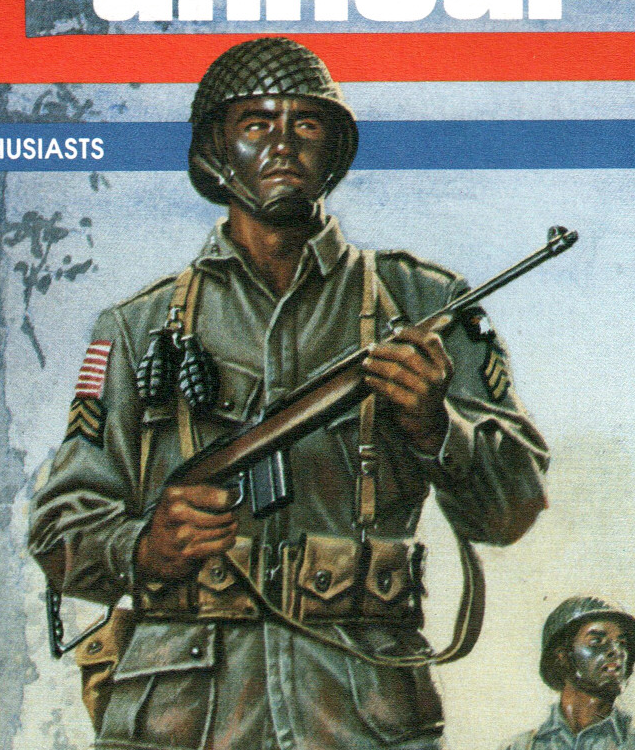
Yanks did nothing for me. But the cover of the Paratrooper module worked on a number of levels. It had an interesting subject, a sergeant of the 101st Airborne Division, the famous Screaming Eagles. Paratrooper provided a convenient segue from SL to ASL. Avalon Hill published the module in order to assist/entice SL players contemplating the transition from SL to ASL. Except for the ASL Rule Book, Paratrooper was largely self contained, requiring only the four original boards from SL to play. Finally, Bill Conner, one of the founders of ASLOK, was a former ‘trooper—in the 82nd All-American, if memory serves me. 
The sergeant still required some work. His blackened face had to go, as it would “muddy” the image at scale. I was loath to remove the grenades and kept them even though they are barely visible on the finished die. The netting on the helmet—Helen’s favourite detail—turned out surprisingly well considering the scale. (Photographs do not do it justice.) But for the most part I had to reduce the amount of overall detail drastically. I must have redone the drawing more than 20 times. Consequently, the paratrooper was the most labour intensive of the four graphics. But it was not the only graphic to require a lot of work.
The trouble with medals
Deciding upon which military medals to pair with my American and British squad leaders should have been a snap. The German and Russian set suggested to many observers that I would use the most prestigious, or highest, American and British military decorations in my designs. I may as well set the record straight. 
Medal of Courage
Where military orders are concerned, the Knight’s Cross with Oak Leaves is a mid grade order of the Iron Cross. There are five grades above it, one of which was never awarded. As I explained in an earlier post, I used this particular grade of the award because it looked the most interesting at scale. The Hero of the Soviet Union is not a military order, but rather an honourary title bestowed upon civilian and military personal for heroic deeds in the service of the Soviet state and society.
Order of Glory
The highest Soviet military order during World War II was the Order of Victory. It was reserved for generals and marshals. The highest medal awarded to a soldier for bravery in battle was the Medal of Courage. Over four million were awarded. The Order of Glory, awarded to non-commissioned army personnel for bravery in the face of the enemy, was less common. Roughly 2,600 soldiers received the First Class of this Order. In retrospect, the Order of Glory may have worked for the Russian set, although the T-35 on the Medal of Courage beckons even now. But in my defence, I still feel that the Hero of the Soviet Union works best. The gold star has good contrast, while the red colour of the die does double duty as the “ribbon” of the decoration. 
Therefore, when it came to selecting medals for the ASLOK set, I did not feel constrained by any particular  precedent, other than using medals, I suppose. Unfortunately, my options, where medals were concerned, proved more limited than I had imagined. The top three candidates for the American die are shown below.
Medal of Honor, Distinguished Service Cross, and Silver Star
The "Gillespie"
I had ruled out the Medal of Honor (MOH) early on. During the war, the US Army had used two different designs: the Gillespie (1904-44), and the current version above. The other difficulty was that the Marine Corps shared the Navy version of the medal. Additionally, some Americans are sensitive about how and where the medal is displayed, and for what purpose. Until 2006, it was illegal to reproduce or sell the medal—some transgressors have paid stiff fines or gone to jail for doing so. However, for my purposes, the MOH was simply too complex a design to replicate well on a die, especially the star-speckled ribbon. 

Military Cross
I initially turned to the Silver Star, which oddly enough, is not silver, save a tiny central star. The Star is not very elaborate, and thus was a good candidate. I even considered cutting out the central silver star so that the green of the coloured die would radiate from the centre. The trouble is that the comparable British medal was actually two medals: the Military Cross (MC), and the Military Medal (MM).6 The former was reserved for junior officers and warrant officers, the latter for the lower ranks. US decorations for bravery make no such distinctions. 
DCM
I had the same problem with the second highest US award for gallantry. The Distinguished Service Cross (DSC) was awarded to soldiers of any rank “for extreme gallantry and risk of life in actual combat with an armed enemy force.” The British equivalent for officers—usually above the rank of Captain—was the Distinguished Service Order (DSO), and for other ranks, the Distinguished Conduct Medal (DCM).7 Moreover, the DSO often was awarded for inspired leadership rather than gallantry per se. The DSC nevertheless had its appeal—at least from a design point of view. 
Photo of DSC
The DSC is fashioned in bronze, which gives the medal a certain understated dignity. The design is not very elaborate either. It features a bald eagle, the national bird of the United States since 1782, and a small scroll with the words “FOR VALOR.” Now work with me for a moment. Remove the eagle, and replace it with a lion. Modify the shape of the cross a bit, and add a “u” to the scroll. Et voilà: a Victoria Cross (VC)—the supreme award for gallantry across the British Commonwealth. 


VC awarded during the Boer War 


I admit that the DSC and the VC are not equivalent awards, but they do have a lot in common. Both are bronze, both feature iconic national or imperial symbols, both are awarded for valour, both are crosses, and neither award discriminates on the basis of rank. The VC is also a good fit because, unlike the MM and the DCM, which some members of the British Commonwealth were not entitled to, the VC could be won by any subject of the British empire. That is how I came to choose a DSC and a VC for the ASLOK set.
Click to enlarge

The trouble with metals
The DSC required the least work of all the designs, but it still took the better part of a day to complete. In order to maximize the amount of detail, I discarded the ribbon and the suspension ring. Not only did this simplify the design, but it also allowed me to increase the size of the cross relative to the surface of the die. But no matter how hard I tried, a lot of detail was lost, including the text in the scroll. This had an unintended consequence. I had dispensed with the (lengthy) name of the award in favour of the official abbreviation, which I positioned to the left of the medal. With the space below the cross now “for let,” I was able to place the text from the scroll here. I am pleased with the result. The text highlights the “linguistic” differences between the United Kingdom and its former American colonies, but for the most part reinforces the elements common to both awards. 
The VC was the more labour intensive of the medals. I cannot recall how many times that I scrapped the design and started afresh. I dispensed with the ribbon for the same reasons as noted above. However, I kept Queen Victoria’s “V” and a portion of the bar above it. Unlike the ring on the DSC, I felt that these small details were an important part of the design. The lion and the crown were the most time consuming details. I had to repeatedly rework them throughout the design process. Having said that, I was surprised that the lion turned out as well as it did on the finished die. 
My troubles with medals did not end here, however. I needed to choose a foil for each medal. My first designs had used gold and silver foils. The DSC and VC are bronze. 
Copper foil
I had a number of metallic foils to choose from, but only three “metal” ones: gold, silver and copper. Although bronze is almost 90 percent copper, the bright copper foil had nothing in common with the dark bronze of the VC above. More problematic, the copper foil would be lost on an amber die. Copper had the opposite effect on the green die. So stark was the contrast that I feared people would find it too garish for their tastes. 
I agonized over the foils for weeks. In the end, I thought that an actual DSC had enough of a sheen that gold foil would be an acceptable compromise. The toughest call was using standard black foil for the VC. I was worried that the VC would be hard to see. While Victoria’s cross does not pop out of the die like the DSC does, I am good with the more subdued feel of the British award. Looked at another way, the foils on the green and amber dice tend to reflect national temperaments: the American predilection for hyperbole (or exaggeration), and the British penchant for understatement. 

Hyberbole...

...versus understatement


So there you have it, my reasons (or excuses) for the final designs of the ASLOK Anniversary set of BattleDice.
I rest my case.
Notes
1. ASLOK did return to Youngstown for a brief period in the mid 1990s, but has been held in Cleveland ever since. So important has this week-long event become, that many third-party publishers make a point of releasing their latest wares at ASLOK.
2. Some might argue that cover art adorned with German soldiers helps sell games. There was undoubtedly some truth to this when SL first appeared. However, I think that it takes more than a “Jerry” on the cover of an ASL Rule Book to get people to open their wallets these days.
3. Without access to the original photograph, I admit that I am speculating with regard to nationality.
4. Strictly speaking, if I were to stay true to the SL legacy, there could be no Italian set. Despite the promise of their appearance—in the forthcoming G.I. Anvil of Victory—as early as 1979, Mussolini’s much-maligned minions did not make their cardboard debut until the release of Hollow Legions, in 1989. 
5. I realize that West of Alamein was the original core module for the Commonwealth, but it has been superseded by For King and Country. As for the second and fourth ASL modules, neither should be considered a “core” module. Paratrooper was essentially a standalone product. The only unique component was board 24 (and the scenarios), which is currently available for purchase separately. The scenarios will reappear in the second edition of Yanks. Partisan! (1987) was a clever stopgap measure, a convenient vehicle for the release of Axis Minor infantry, and little else. The partisan counters have always been part of the Beyond Valor counter mix. With the release of Armies of Oblivion in 2006, the rationale for Partisan! finally evapourated.
6. Technically, there is a third award, the Indian Distinguished Service Medal (IDSM). This medal was conferred to Indians serving with the BIA. Many of these men fought in East and North Africa, the Near East, Italy, and the Far East, especially Burma. More than 1000 IDSM were awarded. Indians also won 30 Victoria Crosses during World War II. 
7. The closest equivalent in the BIA was the Indian Order of Merit (IOM) 2nd Class. The IDSM and the IOM were discontinued after 1947 with the independence of India. In 1993, the British revamped their honours and awards system in an effort to rid the system of bravery awards based on rank. For instance, a new award, the Conspicuous Gallantry Cross, replaced the DSO and the DCM. The MM was discontinued, but the MC was kept, although the latter is now open to all ranks. 

23 February 2012

One for the Road

Advanced Squad Leader legend Bill “Fish” Conner passed away at home on Friday, 17 February 2012. He was 59. 
Darryl “Action Burk” Burk learned of Bill’s passing on Sunday. He had spoken to his long-time friend earlier in the week. Bill had admitted to not feeling well. Darryl posted the following on the GameSquad ASL Forums:
I don’t know what else to say as I’m still in shock. The world has lost a great gamer and I’ve lost a great friend and gaming buddy. Play a scenario in his memory and use Sgt. Conner, I know he’d appreciate it, Hope to see you at ASLOK but it won’t be the same for me. Sorry, the tears are flowing freely now,
Darryl Burk
My condolences to Bill’s family and friends, especially Darryl.
Bill and Darryl go back a long way. They cut their teeth on Squad Leader (SL) during the 70s and 80s. As part of Bob McNamara’s group in Youngstown, Ohio, the pair also did a fair bit of play-testing during the development of the SL gamettes. 
Bill attended the Origins ‘85 tournament where ASL made its historic debut. Upon his return, Bill and Darryl immersed themselves in the new system. When Red Barricades—the first historical ASL module—appeared, the pair practically lived in the streets of Stalingrad, playing one Campaign Game after another. Top players in their day, the pair also gained some notoriety for their “Series Replay” articles—essentially play-by-play narratives of scenarios—published in The General magazine. 
Bill and Darryl continued to support the hobby by play-testing scenarios. But as they later confessed, it was too much, and the pace eventually wore them out. Their last hurrah was with the “desert module” West of Alamein, published in 1988.1 Bob McNamara was the lead developer for ASL at the time. Perhaps Bill and Darryl felt compelled to lend a hand. Whatever the case, other commitments were demanding more and more of their attention. 
This scenario from In Contact has a novel board layout 


In 1989, Bill and Darryl rolled out In Contact. Although this short-lived publication (1989-1990) contained articles and scenarios,2 its original intent was simply to put ASL players in contact with each other. Disillusioned with the direction that the magazine had taken, Bill and Darryl returned to what they loved most: playing ASL. 
Oktoberfest
It was the launch of a modest tournament in 1986 that cemented the pair’s reputation in the ASL world. The first ASL Oktoberfest (ASLOK) was held in October 1986, only a year after the release of the ASL Rule Book. It ran over the Columbus Day holiday weekend—the second Monday in October.3 Bill worked for the United States Postal Service and always had Columbus Day off.4 It was a good fit. The inaugural event attracted 17 players. Attendance almost tripled the following year, and since 1990 has never fallen below 100. 
For the better part of a decade, Bill and Darryl ran the tournament in Youngstown (actually, in nearby Austintown), a small city of 67,000 situated on the Mahoning River, in the county of the same name.5 Youngstown lies in eastern Ohio, ten miles the Pennsylvania State line, and midway between Cleveland and Pittsburgh. It is also midway between New York City and Chicago. So in certain respects, Youngstown and ASLOK were “in the heart of it all.”


Mark Nixon took over the reigns in the mid 90s, and moved ASLOK to its current home in Cleveland. The current Tournament Director, Bret Hildebran, has been running the Oktoberfest for almost 10 years. Today, ASL Oktoberfest is the most prestigious, largest, and longest running ASL gaming event anywhere. It is an event where players of all calibres can meet, play, collaborate on future ASL projects, and most importantly, have fun. 


In a 2010 interview with Dave Kleinschmidt and Jeff Hallett (The 2 Half-Squads), Bill and Darryl explained the rational for their tournament. Their goal was simple. They wanted to ensure that players actually got to play ASL. The pair adopted a round-robin format so that participants would not be eliminated after the first, or even the second round of play. The popularity of their event grew rapidly. Some players began to arrive a day early, then a couple days early. Worried at the increasing numbers of “early birds,” Bill and Darryl added single-elimination, three-round, mini-tournaments. But still they came, earlier and earlier. 
Perry Cocke of MMP
Today, ASLOK is a week-long festival commencing ten days before Columbus Day. The first four days are dedicated to “open gaming.” There are no formal tournaments until the “minis” start on Wednesday.  Players are free to choose opponents and scenarios. Some come prepared to play huge scenarios, and/or campaign games. Most participate in the World Cup by playing someone from the opposite team. The World Cup pits US players against non-US players. Such is the success of ASLOK that Perry Cocke of Multi-Man Publishing (MMP), publicly complimented Bill and Darryl on their legacy. Perry went on to say that ASLOK had been an inspiration for MMP's tournament Winter Offensive. Perry counted Bill among his friends. Like many who knew Bill, he has difficulty expressing how much Bill meant to him and the hobby.
The Gröfaz
As a result of his association with ASLOK, Bill became known affectionately as the Gröfaz, the title awarded annually to the top player at ASLOK. Truth be told, Bill appropriated the title. His friend Darryl had been reading John Ellis’s book Brute Force. Darryl pointed the term out to Bill, and the rest was, as they say, history.  
Gröfaz is a German acronym coined to mock Adolf Hitler: Größter Feldherr aller Zeiten, or Greatest Field Commander of all Time.In the context of ASL, the term is both an acknowledgement of the skill required to win the ASLOK championship, and the recognition that ASL is just game where even the most accomplished remain arm-chair generals. Bill never won the title, but he helped people like eight-time champ Mike McGrath get there. 
Gröfaz has come to symbolize some of the best people within our hobby. In Bill’s case, Gröfaz came to represent something greater. Bill “Fish” Connor was and remains an enduring reminder of all that is good within our hobby. The volunteer spirit, the enthusiasm, the generosity, the sportsmanship, the desire to share the simple joys of gaming and the socializing that goes along with it, not to mention the life-long friendships that come of all this. Bill wanted to put ASL players in contact with each other. He and Darryl have done so much more than that.
A personal recollection
I did not meet Bill until 2007. Until then he was a familiar name from The General magazine. How could anyone forget a nickname like “Fish?”7 Like so many other ASLOK neophytes, I was struck by how easy going and approachable Bill was. He put me immediately at ease.
Apart from SL/ASL, we had a couple of other things in common. Like our fathers before us, we both served in the army. And coincidentally, his father William took a German wife (Wilhemina Baumgartener) while serving in Europe, just as mine did a couple of decades later. But there the similarities ended. 
Bill was born William F. Conner in Denver, Colorado on 10 September 1952. But Ohio would become his home. He completed high school in Youngstown, and spent most of his working life as a postman with the Post Office in nearby Austintown. Bill was a veteran. He served in Europe during the Cold War, and he kept in touch with old friends through the Akron, OH Chapter of the 82nd Airborne Division Association. 


Bill had other interests and talents. For instance, he was a big Strat-O-Matic Basefall fan. I am certain that some of his friends have fond memories of playing this game with Bill. 


I know for a fact that many ASL players shared his love of music. For years Bill would show up at ASLOK, not play to ASL, but to socialize and jam late into the night. He played guitar, but had a soft spot for the harmonica.

One for the road
recall shaking Bill’s hand again at ASLOK in 2010. We chatted a bit, and I watched Darryl and him play Guards Counterattack. It was a special moment, their first game in 15 years.


However, this past October I was rushing about so much that Bill and I only exchanged smiles and brief hellos. I had intended to check in with him later, but missed my chance. It is hard not to feel regret. I can nevertheless count myself among the fortunate few who have met Bill. I was not his friend. Nor was I one of his gaming buddies, or a fellow musician. I was just another ASL player. But like everyone he met at ASLOK, he treated me like I was a friend.
An ASL, elder statesman has passed. But his vision lives on.
Below is an extract of a Series Replay published in The General 25 years ago. I was only 24 when I first read it. Time passes so terribly fast. Be sure to spend some of it with your friends.
SERIES REPLAY7
Streets of Fire, Scenario 1 “Guryev’s Headquarters”
German Player—Darryl Burk
Russian Player—Bill Conner
Neutral Commentator—Mark C. Nixon
Bill Conner has long been a familiar figure in the final rounds of tournament play, winning a healthy share of Squad Leader and Advanced Squad Leader events not only at Origins, but at a number of other conventions. He first became involved with SL through playtesting with Bob McNamara’s group in Ohio, and most recently Bill has organized his own SL/ASL tournament-the Oktoberfest, which makes its second annual showing this fall. 
Darryl Burk was also involved in the McNamara playtest group. He has always been a tenacious opponent and can lay claim to having beaten Bill more times than everyone else in the world combined. 
Mark Nixon is readily recognizable to our long-term readership, having crafted a number of articles on G.I. [Ed. G.I. Anvil of Victory, the last SL gamette] some issues back. Though he has won many ASL events, he is quick to point out that none have required him to face either Bill or Darryl, making him content to look over their shoulders on this meeting.
Opening Comments
Russian: Since meeting through The General’s “Opponents Wanted” column early in 1982, Darryl and I have been each other’s principal and toughest opponent, teaching one another the game system along with many valuable lessons. Having played hundreds of scenarios—published and in playtest—we are well accustomed to each other’s style of play. Darryl is not afraid to try the unorthodox, and will seldom use the same plan even if previously successful. His greatest weakness is in feeling sorry for me while destroying my forces. He takes his lumps better than I and deserves much of the credit for my tournament successes.
We chose to play “Guryev’s Headquarters” because it is our favorite Streets of Fire scenario, maybe even our favorite of all those for ASL. It is the quick-play piece of Deluxe ASL, much as the SL classic “The Guards Counterattack” was for the original game. It is a simple, small-area action utilizing only basic infantry; only this time it is the German line infantry attacking the Russian elite forces instead of vice-versa. This replay should be easily followed by experienced ASL-ers, SL-ers, and maybe even the uninitiated. We highly recommend playing it several times because it is extremely enjoyable as a training scenario for those new to the gaming pleasures of the ASL system. insert pic of dice
Each ASL scenario has a balance provision, which is influenced by our choice of sides. It tends to make for some very interesting variations while also keeping players from being overly greedy. Usually, this is some kind of relaxed Victory Condition, terrain or troop alteration, or even some special restriction on the enemy player. It all boils down to one thing: if each player wants the same side, a die is rolled with the winner getting to play that side and the loser getting the balance provision in his favor.
Although I would rather play as the German in this scenario, in order to be on the attack, I chose the Russians. My reasoning is that if “Action Burk” also chooses to play the Germans, one of us will get the Russians and the HQ fortified. This doesn’t sit too well with me, unless I were to get that fortified building, because I feel that it makes the Russians a little too tough, whereas the reinforcement restriction by both of us choosing the Russians is much less dramatic. Besides, the Russians have been winning a lot lately.
German: I consider “Fish” [Bill Conner] to be the ideal opponent, not just for ASL but for any game. The traits that have made him a master of the SL/ASL system apply to any game he plays. First and foremost, he is an outstanding gamesman and good sport. Over the course of hundreds of games I’ve never known him to lose his temper because of an unfavorable result, lost game, or for any other reason. His gaming ethics are matched in quality by his skill in actual play.


My choice to play the Germans in “Guryev’s Headquarters” was based mainly on the results of our previous experiences with it. While it appears an easy scenario for the Germans to win, the Russians have won whenever building bEl was strongly defended (which is most of the time). Though I have lost several times as the German player, I have a plan for the Germans to take that building and I am eager to try it out. 
Also, I don’t want the balance provisions to come into effect if Fish and I both chose the same side. Here I’ve tried to outguess Conner. If he should choose the Germans to play, thus giving the Russians fortification of building dL1 on the ground level, I feel my plan for the Germans would still work if I win the die roll for sides and get the Germans. The fortified building would not hamper my plans that much. However, if I lost the dice roll, the fortified building would be a nice refuge to weather the fury of Fish’s attack.
Neutral Commentator: I first met “Fish” Conner and “Action Burk” when they entered the G. I. tournament at Origins ‘83. In a field of 28, I had them ranked #I and #6 respectively, based on a short questionnaire I used to seed the tourney. Today I would change only one thing: I would now rank Darryl higher than I did then. 
They have played each other hundreds (yes, literally hundreds) of times. This is their eighth confrontation at “Guryev’s Headquarters”, so I expect this replay to reflect their familiarity with one another’s style of play as well as the general situation. They have previously tried several tactics, including an end sweep across the south side of the battlefield, the “north board edge creep,” and the “up front defense” in building bE1 with remote firebases (such as dH3, second level).
As luck would have it, this game is something of a special occasion for our antagonists. This playing marks their 100th ASL confrontation. Their caliber of play is very high, so expect a clean, crisp game.
[Ed. If you have not played this classic scenario, I urge you to do so. I have played it perhaps a dozen times. It is always a treat to play.]


On 5 March 2012 Mark Nixon wrote:
I am deeply saddened with the passing of Bill Conner. All my sympathy goes out to his family and friends and of course most of all to Action Darryl. What a serious loss to the ASL community. This is a guy we cannot replace; we can only accept the loss and remember him, honor him and carry onward as he would want us to do. Gamer #1 is down. ASL would not be the same today without Bill Conner; he made things happen which would not otherwise have taken place, and I think it is most appropriate that some are planning to find the right way to venerate him at ASLOk. Bill was always a tremendous friend and a talented player, mentor, thinker, competitor and set a high standard everywhere he engaged his tremendous energies. The guy was simply brilliant and I will miss him as long as I live. GROFAZ!

Notes
1. Bill is also credited with helping play-test the scenarios in The Last Hurrah. Published in 1988, this module contained a partial order of battle for the Allied Minors. It was superseded by the module Doomed Battalions, released in 1998. Darryl advised me on 25 February that Fish was playing Squad Leader during the 1970s, but that he did not pick up the game until 1980. Bill was part of Bob McNamara's play test group for Crescendo of Doom. Darryl joined the group for the play testing of GI Anvil of Victory. The pair later play tested ASL for "Mac" and Rex Martin. The last module that Darryl recalls play testing with Bill was West of Alamein
2. Of the dozen scenarios published by In Contact, eleven were reprinted by Multi-Man Publishing in their “retro” ‘zine Out of the Attic 1. The scenarios featured the work of at least nine designers. Although they may have had a hand in testing some of the scenarios, to my knowledge neither Bill nor Darryl designed any of them.
3. Coincidently, Colorado—where Bill was born—was the first US state to declare Columbus Day an official holiday in 1906.
4. Before becoming a letter carrier, Bill had served with the 82nd Airborne Division. There was a time in the 1980s when he was hooked on the card-based variant of Squad Leader called Up Front! So keen was he to get home to play that he would occasionally do the “airborne shuffle,” a kind of slow jog, for his entire route.
5. In point of fact, the tournament was run in Austintown, some 10 kilometres west of downtown Youngstown, for eight years. As Darryl clarified on 25 February, he and Bill also ran ASLOK in Brookpark, a city adjacent to Cleveland and the Cleveland International Airport. I attended my first ASLOK (2007) in Brookpark. The new venue in Cleveland is not far from the old one, but the new one is miles ahead of its predecessor in so many respects.
6. The term is attributed to Field Marshall Wilhelm Keitel. Although no fan of Hitler, Keitel had given up trying to argue with the Führer. Incredibly, Hitler took the comment at face value, oblivious to the fact that Keitel was far from sincere. The term persisted. Indeed, General Heinz Guderian once showed his scorn for Hitler’s amateur prosecution of the war by referring to him as the Gröfaz.
7. For those interested in such things, Bill’s nickname predated his involvement in ASL. The monicker is actually a contraction of a longer nickname: Fish L. Pou, pronounced like the Pepe le Pew of Looney Toons fame. Bill acquired his nickname while working in a grocery store. One of his jobs involved putting up signs for fish, veal and poultry. The signs tended to overlap. When they did, they spelled “FISH L POU.” Overtime, this was shortened to Fish. But I much prefer the fanciful tale below, posted by “Psycho” on the GameSquad ASL Forums.
Back when I had my falling out with Mark Nixon I decided to look up another ASL stud, Bill Conner. I went to the Cleveland area but couldn’t find him. I got word that he was in Spooner, Wisconsin so I went there. When I got there I hear that he just left for Truth or Consequences, New Mexico. I followed him there only to find he was ducking me by running all over the country.  I finally tracked him down in a little shack outside Lincoln, Montana. He was living there with a guy named Ted who kept to himself. 
I sat him down and forced him to play ASL with me while Ted sat at his typewriter and mumbled to himself. I thrashed him soundly and taught him a thing or two about real ASL and not that bastardized version he played. He didn’t even own the rulebook!  
We stayed there and played for a few months. I tried to teach him properly but he kept walking into every trap I laid for him. His roomie, in one of his few moments of clarity, said it was like shooting monkeys in a barrel and started calling him “chimp.” I told him it was fish and that’s where he got the name. He didn’t like his new nickname and Ted mocked him endlessly with it. 
I finally got tired of the beatings I was dishing out and felt it was time to move on. On my way out Ted asked me to mail a package for him. Sure, what could it hurt?
7. The General, Vol. 24, No. 1, p.10-18 (Avalon Hill Game Company: 1987).