Showing posts with label siege. Show all posts

20 July 2011

DHL Delivery! KGS (Cholm) Update


Kampfgruppe Scherer: the Shield of Cholm (KGS) has arrived. We have let everyone who pre-ordered a copy know. Now it is time to let the rest of you in on the secrets.
First, I must say that I am particularly impressed with the historical and rule booklets. Both are printed on the same high-quality stock that Le Franc Tireur (LFT) uses for its magazines. The historical booklet is just over 50 pages. In addition to before-and-after photographs of the siege, the booklet is littered with contemporary photographs, mini biographies of key Germans, maps, aerial photographs, orders of battle, and colour illustrations. Much of this material has been provided by researcher Dirk Burgdorf, who has conducted extensive on-site research of the battlefield. He has also interviewed a number of veterans of the battle, including Iron Cross First Class recipient Joachim Dettmann. Leutnant Dettmann won his Eisenkreuz while serving as an artillery observer during the siege. There is also a 13-page excerpt from Jason D. Mark’s history: Besieged: the Epic Battle for Cholm. The historical booklet is a treasure trove of detail that adds considerable value to the module.
While quantities last, KGS is $105 from our KitShop.


On time, on target...
Air dropping supplies is fraught with problems. Even if the load is dropped on target, the supplies inside the canister can be damaged. This was the case with some of our KGS modules that arrived today. 
I opened the box that appeared to have the most damage, and checked the contents. The picture above shows part of the contents of this box. Nothing inside showed any significant damage. The historical booklet, for example, has some crimping on the top right-hand corner (about 2 mm). Some of the counters have come loose from their tree, but this is not unusual with LFT counter sheets—their punch is extremely sharp! The maps, overlay, and various cards were undamaged. All in all, much better than I had feared. 
Damaged copies of KGS are available, as is, for $95 each.


As an added incentive to purchase a copy of KGS from our KitShop, we are offering discounts on other LFT products. These discounts apply even if you purchase a damaged copy. Below are the regular and discounted prices for a number of LFT scenario packs and magazines. Although we also stock From the Cellar 4: the Russian Civil War, and Operation Chariot: the Raid on St. Nazaire, we regrettably cannot offer a discount on these publications at this time.


UPDATE: 21 July
I just wanted to let everyone know that Xavier Vitry, the editor of Le Franc Tireur, has been very supportive and understanding with regard to the unfortunate "canister drop." I also wanted to reiterate that there was very little damage to the contents of these boxes.


From the Cellar 6
This is the latest LFT scenario pack. As the cover teasingly suggests, the scenarios are all short, four-to-six turn actions that can be played in less than four hours. I have played four of the ten scenarios in the past three weeks. The longest took about four hours to play. So far FT165 Shopino Struggle and FT167 Wasp Sting have proven the most popular. I also thought that FT163 The Price of Persia (Iranian versus  Indian troops) was a good scenario for teaching new players the basics of Infantry combat. One of the scenarios—an all metal bash—features six French armoured cars in a whirling battle with eight panzers. It is another good candidate for a “training” scenario. In sum, there is a lot of variety in the pack.


From the Cellar 5
The rat brings us another mixed bag of scenarios, 14 in all. The pack comes with two articles on the battle of La Horgne, which takes place in France in May, 1940, and a mapboard (LFT2). Noted British historian and ASL player Ian Daglish penned one of the articles. In addition to the four early-war scenarios in France, there is a rare scenario using Steppe terrain. A PTO night action (one of two night scenarios in the pack) uses the mapboard that comes with LFT11 (see below). There is a cool match up between the Red Army and an allied force of Italians and Germans: FT152 Avanti! FT158 Close Combat Teams sees a dug-in Japanese force defending against a combined arms Russian assault that uses the board that is included with this pack. If you love late-war armour, FT157 The Lost Column may be for you. The Canadians are hard-pressed in this one. They need to fend off a company of the 12th SS supported by Panther and Tiger tanks. There are plenty of medium-sized scenarios in this pack. Finally, one of the smallest scenarios uses the Spanish counters that come with LFT10 below, although standard German counters work just as well in this Ostfront firefight.


LFT Magazine 12 
An 80-page magazine with an emphasis on the Pacific Theatre of Operations (PTO). It includes ten scenarios and a (corrected) board LFT2. Given the theme, subjects include an overview of Japanese characteristics in ASL, PTO terrain, and a how-to article on sea-borne assaults. One will also find information on the Chinese Civil War, Japanese island defences, and other historical subjects. If you are interested in PTO, you will find much in here to your liking. I cannot comment on the scenarios, as I have yet to play any. I just started playing a few PTO scenarios last year, after a 20-year hiatus.
Board LFT2 comes with LFT Issue 12, and FTC 5


LFT Magazine Issue 11
My favourite issue because it has a rare picture of me playing a game at ASLOK that I actually won! Seriously, this is a polished issue concentrating on France 1940. There is an extremely well done article on Stonne, complete with aerial photograph and hex-grid overlay. All ten of the scenarios  that come with the magazine feature French troops. (The scenarios are printed on A4 cardstock inserts.) Eight take place in France, including a little-known action where Italians attack French positions along the Mediterranean coast. Another takes place in Belgium. The most unique stars French colonial troops in Indochina. Scenario FT98 And Then They Landed uses mapboard LFT1, which comes with the magazine. The Japanese must storm ashore in landing craft and push inland—a nice primer for sea-borne assaults. The magazine’s 80 pages are chock-a-block with articles such as Franco-German infantry tactics, Gun Duel, Platoon Movement, and Group Solitaire ASL.
Board LFT1 comes with LFT Issue 11. Shown is only half of the map. The entire map is only a thin strip of land one to three hexes deep. Most of the map is ocean/river. In scenario FT98, the Japanese landing craft must start the game at least five hexes from the beach.


LFT Magazine Issue 10
One of the most sought after of the LFT magazines, this 80-page issue focuses on the Spanish volunteers who served with the Wehrmacht. If you are a fan of the Ostfront, this issue may be for you. The 10 scenarios in this magazine capture some of the action between the Spanish and Russians, including a final battle in the streets of Berlin. There are superb articles on the history and operational employment of the Division Azul, or 250. Blaue Division, as the Germans referred to this division, which operated under German command. What makes LFT10 especially attractive is the Spanish counter set. The sheet contains enough Spanish infantry to play all of the scenarios in the magazine. As an added bonus the sheet includes counters representing pre-1942 German paratroopers, as well as “opportunity fire” and “SW First Fire” counters, to name a few. I have played more than half of the scenarios in this magazine, several more than once. 
The quality of these counters is superb


06 July 2011

KG Scherer: the Shield of Cholm

Le Franc Tireur (LFT) has announced the release of their new historical ASL (HASL) module depicting the siege of Cholm, or Kholm. The siege lasted more than 100 days, beginning with the Soviet encirclement of the town in January 1942. Kholm is a small town in Russia, situated at the confluence of the Lovat and Kunya Rivers, some 100 kilometres north by northeast of Velikiye Luki.
KGS Contents


Below is a contemporary sketch of the cauldron by Polizei-Rotwachtmeister Schlimmer, of Reserve Polizei Battalion 65. A talented artist, he also co-designed the Shield of Cholm.


Legend
Compliments of Andrew Hershey
1. The “Judentempel” drew repeated artillery fire because the Soviets suspected that German forward observers were using the building to call in artillery. Judentempel is a term coined by the Germans within pocket to describe a former church. Before the Russian Revolution (1916) the building was known as the Church of Christ’s Appearance. By 1942, however, the structure had undergone dramatic renovations, including the loss of its bell tower and much of its classical façade, although its rotunda remained. These alterations left the exterior of the building looking somewhat like a synagogue, hence the name “Jewish Temple.” In any case, it is doubtful that the building actually was a synagogue during the Stalinist period. (That said, the 1926 census lists 103 Jewish inhabitants in Kholm, as the Russians called it.) This imposing stone structure dominated a portion of the town centre. The building features prominently in several of Richard Muck’s photographs in the slide show above. The circular roof is an unmistakable landmark.
2. The GPU prison was a key defensive position in the eastern portion of the town. It was here that Hauptmann Albert Biecker earned his Ritterkreuz on the 20th of March. And it was also here that Beicker would be killed on the 1st of May, only a few days before the siege was broken.
3. Das Kino (cinema) was one of the main Soviet staging areas for attacks against the prison.
4. The “Alte Panzernest” (literally old tank nest) was an area where Soviet armour routinely formed before attacks against the eastern part of the town, especially the prison. The “Neue Panzernest” was located farther east in a forested area, as the old staging area came under increasing German artillery fire directed from the prison.
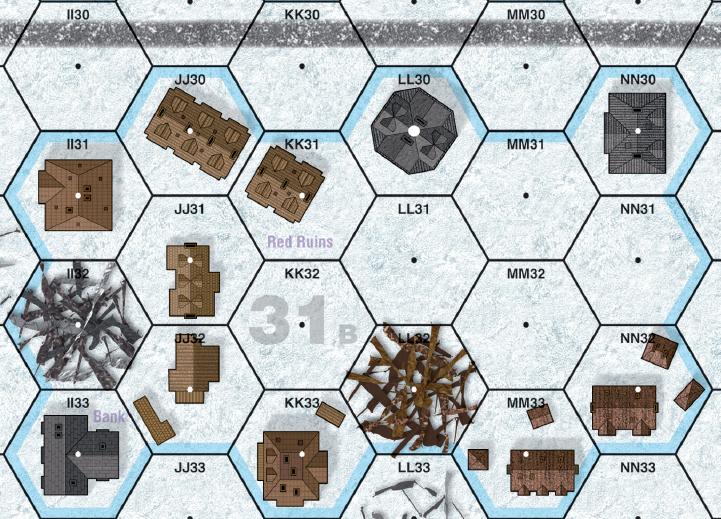
5. The “Rote Ruine” (red ruins) was a place of savage fighting that changed hands several times during the siege. It was a popular hide for opposing snipers. The nickname is a reference to fine red dust of pulverized bricks that blanketed the buildings, rubble and debris of this block.
6. “Der Lausepelz” (lice pelt) was a collection of wooden buildings that were eventually rubbled. It was a prominent Soviet position, and a jumping-off point for infantry assaults.
7. Der Nordfriedhof (northern cemetery) was a heavily fortified area, and the scene of see-saw fighting. When in Soviet hands the nearby church tower served as an artillery observation post. By May, the church was no more, having been battered by artillery, and finally consumed by fire.  
8. Kirche im Osten (literally church in the east) was used as an artillery observation post by the Germans. It was also an important defensive position in the eastern portion of the pocket. The crypt of the church was, for a time, the battalion command post of Hauptmann Heister, commanding officer of III Battalion, Infanterie Regiment 386. Like most of Cholm, the church lay in ruins by the end of the siege.
9. The final headquarters of “Kampfgruppe Scherer.” The first HQ was located on the east bank of the river, but was abandoned when the Soviets threatened this sector of the line.
10. Die Haarnadelkurve, or hairpin curve, was the primary drop point for supply containers. The main field hospital and ammunition dump were located here, in the western part of the town.
11. An improvised airstrip where Junker 52 transports and Gotha 242 gliders landed. The strip was located in no-man’s land.
12. The Tannery. Once the Russians secured this building complex, they used the larger building as an artillery observation post. The complex was also used as a staging area for some attacks on Cholm.
Generalmajor Theodor Scherer flanked by Polizei-Rotwachtmeister Schlimmer (holding what looks to be his sketch book), and Kriegsbereichter Richard Muck (with camera). 
The outcome of this oft overlooked siege would have disastrous consequences for the German 6th Army at Stalingrad later that year. The small German force of mostly second-line troops and security forces in Cholm was able to hold out by receiving just enough supplies by air. Luftwaffe transports and gliders suffered heavy losses, however. Ecstatic that the garrison had held out until relieved in May, Hitler commissioned a special award for the survivors: the Shield of Cholm. Their heroic stand would lead Hitler to insist on more and more of his soldiers holding their ground instead of sensibly withdrawing when faced with imminent encirclement by the Red Army.


Veteran designer Andy Hershey recreates the siege of Cholm in a way never attempted in any previous HASL. Because the battlefield changed so much during the course of the siege, and because the landscape was transformed after the snows melted, the module comes with winter and summer (technically spring) maps. However, this is not simply a case of painting one set of maps white. On the contrary, the terrain on each map set differs due to the accumulated destruction wrought by artillery and combat.
The module includes a historical booklet that contains some of the original research undertaken by Andy and his collaborators. A nice touch is the counter sheet. In addition to special counters such as ammunitions dumps, it includes Infantry counters in winter camouflage.


In June, I ordered copies of this innovative HASL from Xavier Vitry, the editor of LFT. I hope to have them for sale in our KitShop sometime later this month, or early August. Several people have already pre-ordered copies.
As an aside, Xavier kindly donated a copy of Kampfgruppe Scherer: the Shield of Cholm as a prize for the Canadian ASL Open (CASLO) in September. The winner of the CASLO will take home this marvelous new release from Le Franc Tireur. Copies also will be for sale at the tournament.


I will post more pictures of the module as they become available. In the meantime, here is what is inside the box:
Contents
Rules booklet 
Historical background booklet 
15 scenarios 
2 campaign games
1 counter sheet: 
130 x ½” counters; and 
88 x ⅝” counters 
1 A4 overlay 
3 A4 players aid sheets 
2 A5 small player aid sheets 
2 A1 maps Winter
2 A1 maps Summer
A1 sheet: 594 mm x 841 mm/23.39” x 33.11”
A4 sheet: 210 mm x 297 mm/8.27” x 11.69”
A5 sheet: 148 mm x 210 mm/5.83” x 8.27”


Note the "Judentempel" near the top of the map. It is surrounded by -1 TEM (paved areas). The area was used as a kind of market square. According to the designer, the three buildings immediately to the south were "market" buildings where people came to trade and peddle their wares.
Note the use of varying shades of grey used to denote the lower elevations near the river.
Red Ruins Block
Scenarios
Kampfgruppe Scherer : The Shield of Cholm includes: 
ID         Name                           Turns   Date (1942)
Winter Map Scenarios
KGS 1    Slayed                          6.5      18 Jan         
KGS 2    Their Fate Sealed?          13       23 Jan         
KGS 3    Reclamation                   7.5      27 Jan         
KGS 4    From Matilda with Love    7         14 Feb         
KGS 5    Red Army Day                7         23 Feb         
KGS 6    Biecker’s Bastion            4.5      10 Mar         
KGS 7    Contested Canisters        6         11 Mar         
KGS 8    Battle in... Organ Gully    5         25 Mar         


Summer Map Scenarios

KGS 9    Lost in a day                  7.5      10 Apr        
KGS 10  Red Ruin Roulette            5 1 May         
KGS 11  Knock! Knock!                 5        1 May         
KGS 12  May Day – East side         8        1 May         
KGS 13  May Day – West side        7        1 May         
KGS 14  Regained in a Day            9        1 May         
KGS 15  Fighting Over Dead           6        8-9 Jun         
Campaign Games
KGS CG 1 Red Army Day      4 days    23 Feb   Winter map
KGS CG 2 Five days in May   5 days    1 May    Summer map

Here are some books dealing with Cholm. Besieged: the Epic Battle for Cholm by Jason D Mark is the most recent study of the battle. 


Arguably the best contemporary source was written by Kriegsbereichter (war correspondent) Richard Muck. He was flown into the pocket (Kessel) in March 1942 at the behest of Generalmajor Scherer, the commander of the German forces trapped in the pocket. Muck was a member of a propaganda unit and subsequently published a book on the battle entitled: Kampfgruppe Scherer: 105 Tage im Kessel von Cholm (105 Days in the Cholm Cauldron). The book is hard to find, but is available on Amazon in Germany. Incidentally, each survivor of the siege received a copy of this book, in addition to the Cholm Shield. The book was originally published in 1943.


Circle of Fire: the Epic Battle of Cholm (left, and bottom centre, with no image) is an anglicized version of Muck's work. It features photo captions in English, and added commentary drawn from other contemporary German sources. This commentary provides more detail on each month of the siege.


There are additional works on Cholm, but most are either in German (including a history of 329. Infanterie-Division, an ersatz formation), or of questionable value. The McTaggart book below includes a chapter on Cholm. I consulted this book for another project and found it to be fairly generic with not a lot of specific tactical detail. It does offer a good overview, however. I found it in my local university library. I recommend that you do the same. The last book is a historical novel. The fellow who runs a "walking the battlefields" blog recommends the book. The link below does allow a sneak peek inside the book. Thanks to C. Dawson for the tip. He managed to find a copy for $4.00, shipping included!


More details here.